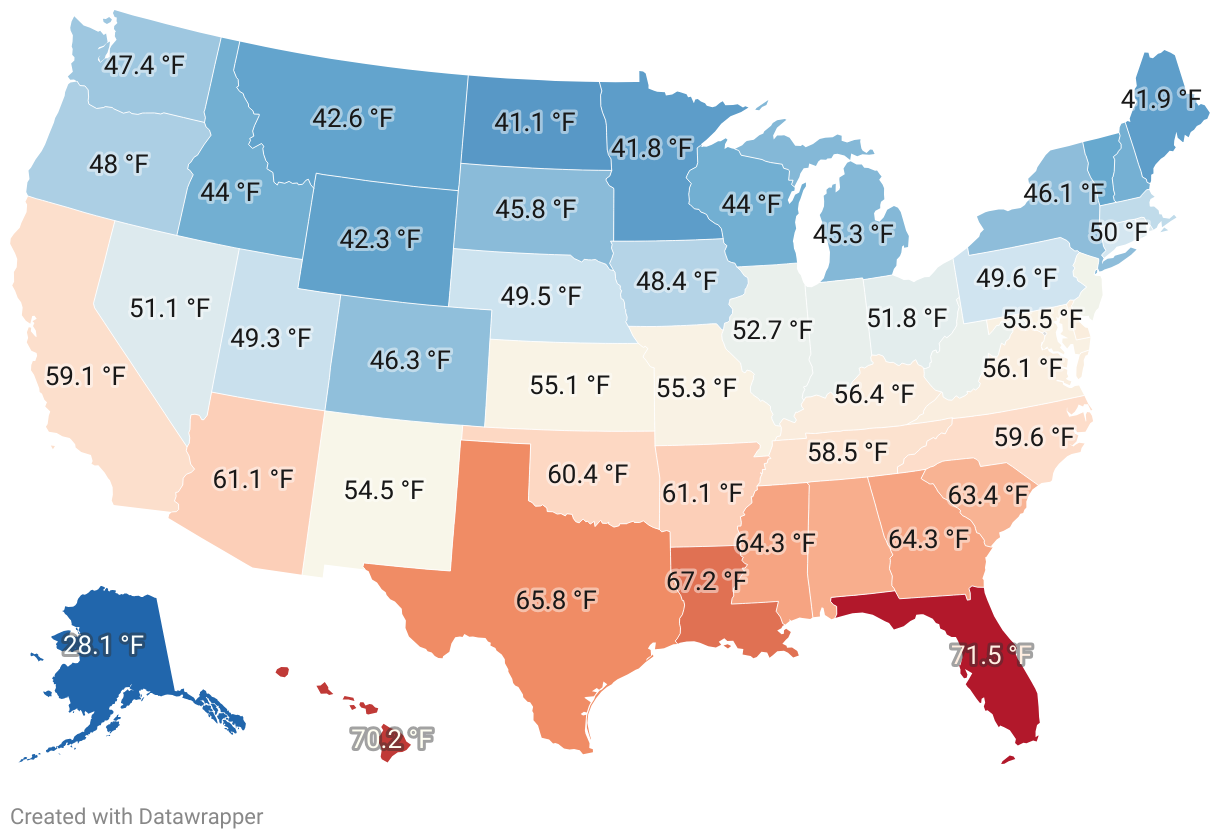
You think you know where it’s hot. Florida, right? Or maybe Arizona? Honestly, if you’re planning a move or just a long road trip, looking at a single "average" number for a whole state is a great way to end up miserable and underdressed. Weather is weird. It’s localized, stubborn, and often contradicts the stereotypes we’ve seen on postcards for decades.
Average weather by state is a tricky metric because states aren't uniform blocks of air. Take California. You have the literal hottest place on Earth in Death Valley, yet you can find people shivering in parkas in San Francisco during July. Basically, the "average" tells you almost nothing about the lived experience of a place.
But we still need the data. Understanding the baseline helps us see how things are shifting—and they are shifting fast.
The Heat Kings and the Cold Truth
Florida officially holds the crown for the highest average annual temperature in the U.S., hovering around 71.5°F. It's the only state in the lower 48 that feels like a sauna for nine months of the year. But here’s the kicker: Hawaii is actually more "consistent." While Florida swings between sticky summers and the occasional winter cold snap that kills the iguanas, Hawaii stays locked in a gorgeous 70-to-80-degree window almost year-round.
Texas is another beast entirely. It ranks fourth-hottest overall with an average of about 65.8°F, but that number is a total lie if you live in Amarillo versus McAllen. In 2021, we saw that "average" doesn't protect you from the extremes; a massive arctic blast sent temperatures into the negative teens in places that usually don't even own a heavy coat.
The Chill Factor
On the flip side, Alaska is, unsurprisingly, the coldest. Its annual average temperature is a brisk 28.9°F. That’s below freezing. For the whole year. If you look at the contiguous states, North Dakota takes the trophy for the most extreme winter risks.
Louisiana and Mississippi often tie for the most humid spots. It’s one thing to have a high temperature; it’s another to have a heat index that hits 120°F because the air is too thick with moisture for your sweat to evaporate. That is the reality of the Southeast.
Rain, Snow, and the Myth of "Sunny" Seattle
Most people think Seattle is the rain capital of America. It isn't. Not even close.
Seattle gets about 38 inches of rain a year. Compare that to Miami, which gets 60 inches, or Mobile, Alabama, which often tops 65 inches. The difference is the flavor of the weather. Seattle has "the gray." It’s a constant, misty drizzle that lasts for days, making it feel wetter than it actually is. In the South, you get "the deluge"—an hour of rain so hard you can't see the hood of your car, followed by blinding sunshine.
The Wettest States
- Hawaii: This is a bit of a cheat because of Mt. Waialeale, one of the wettest spots on the planet.
- Louisiana: Tropical moisture from the Gulf is a relentless rain-maker.
- Mississippi: High humidity meets frequent storm tracks.
- Alabama: Mobile is consistently one of the rainiest cities in the country.
If you hate rain, head to Nevada. It is the driest state in the union, averaging a measly 9.5 inches of precipitation annually. You could fit its entire yearly rainfall into a single afternoon thunderstorm in New Orleans.
Why the "Normals" Are Changing
The National Oceanic and Atmospheric Administration (NOAA) updates its "Climate Normals" every ten years. The most recent set, covering 1991 to 2020, showed a massive shift. Basically, the map is getting warmer. The "average" weather we used to rely on in the 80s and 90s is gone.
The Northeast is warming faster than almost anywhere else in the winter. States like Maine and Vermont are seeing their average lows climb, which sounds nice until you realize it’s ruining the ski season and the maple syrup harvest. Meanwhile, the Southwest is getting drier. Arizona and New Mexico are locked in a cycle of "hotter and longer" droughts that make that 70-degree average look like a distant memory during a 115-degree July.
The "Windy City" Lie
Chicago isn't even the windiest city. That’s a political nickname, not a meteorological one. Cities like Boston, New York, and even Dodge City, Kansas, usually have higher average wind speeds. If you want a state that truly blows, look at Wyoming. The wind there is a physical presence; it’s relentless.
How to Actually Use This Info
If you’re looking at average weather by state to decide where to live or travel, you have to look deeper than the annual mean. A state with an average of 55°F could mean a lovely, temperate year (like parts of coastal California) or a year of brutal 100°F summers and -10°F winters (like Illinois).
Actionable Insights for Your Next Move:
- Look for "Degree Days": Check the "Heating Degree Days" (HDD) and "Cooling Degree Days" (CDD) for a specific city. This tells you how much you'll actually spend on AC and heat.
- Check the Dew Point: Ignore "Relative Humidity." The dew point is the true measure of how "gross" the air feels. Anything over 65°F is uncomfortable; over 70°F is miserable.
- Elevation is Everything: In states like Colorado or Arizona, driving 30 minutes into the mountains can drop the temperature by 20°F. Never trust a state-wide average in a mountainous region.
- Verify the "Recent" Data: Ensure you are looking at the 1991–2020 normals, not the 1901–2000 datasets. The world has warmed by about 2.5°F since then, and that makes a huge difference in local ecosystems.
Check your specific county's vulnerability using the National Risk Index if you're worried about extremes like hail or derechos. Knowing the average is a start, but knowing the extremes is what keeps your basement dry and your pipes from bursting.