Elvis Presley was a man of contradictions. We all know the jumpsuits, the karate kicks, and the pill-bottles, but the guy's internal spiritual life was a whole different beast. He wasn't just a rock star; he was a seeker. Honestly, if you look at his 1971 recording of Miracle of the Rosary, you see a side of him that doesn't quite fit the "Hillbilly Cat" image. It’s a track that feels a bit out of place in his discography, yet it’s exactly where he needed to be at that moment.
People often forget how much Elvis loved gospel. He’d spend hours after a Vegas show—dripping in sweat and adrenaline—hunched over a piano in a penthouse suite singing hymns until the sun came up. He didn't just sing them; he breathed them. But "Miracle of the Rosary" was different. It wasn't a Pentecostal barn-burner or a Southern spiritual. It was a Catholic-inspired ballad written by his childhood friend, Lee Denson.
The song captures a specific, quiet vulnerability. It’s haunting.
Why Elvis Presley Recorded Miracle of the Rosary
So, why did a guy raised in the Assembly of God church decide to record a song about the Rosary? You have to understand his relationship with Lee Denson. Denson’s father had actually helped Elvis with his guitar playing back in the Memphis housing projects. There was a deep, loyalty-based bond there. When Denson brought him the song, Elvis didn't see a religious conflict. He saw a beautiful melody and a message of hope.
Recorded in May 1971 at RCA's Studio B in Nashville, the session for Elvis Miracle of the Rosary wasn't some grand, over-produced event. It was part of the sessions that eventually gave us the Elvis Now album. If you listen closely to the master take, you can hear the restraint in his voice. He isn't growling. He isn't using that operatic vibrato to shake the walls. He’s singing it like a prayer. It’s subtle. It’s delicate.
Elvis had this weird, eclectic spirituality. He wore a Hebrew "Chai" necklace, a Star of David, and a Cross. His logic? "I don't want to get left out of heaven on a technicality." Recording a song about the Virgin Mary was just another piece of his search for something bigger than the fame that was slowly crushing him.
The Lyrics and the Meaning Behind the Music
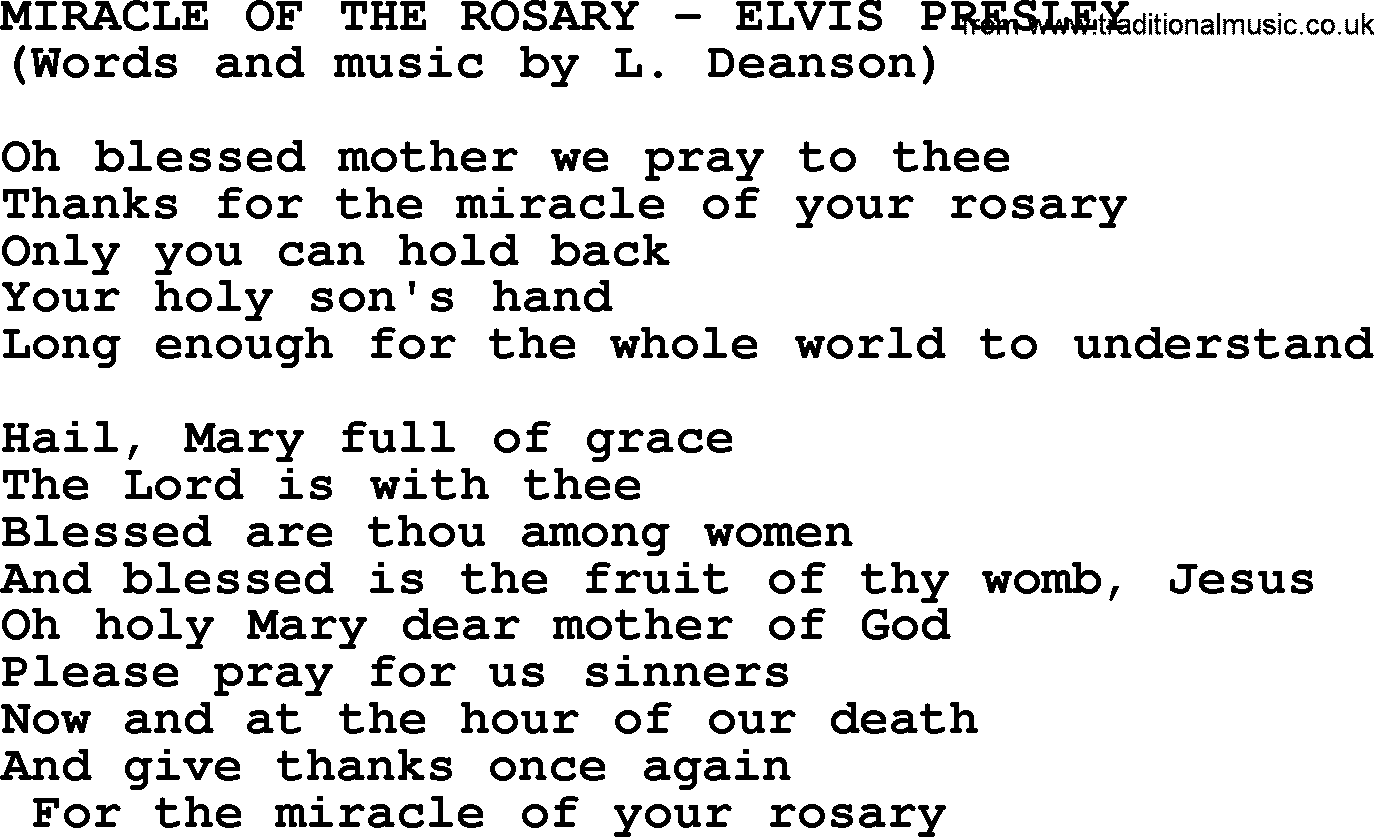
The song itself is pretty straightforward. It’s a plea for intercession. "Oh, Mother of mine," the lyrics go, "I’ll say the Rosary, at thy feet I will kneel." For a guy who was essentially worshipped as a god by millions, there's something incredibly heavy about him singing lyrics about kneeling at someone else's feet.
It’s about the "Miracle of the Rosary" bringing peace.
By 1971, Elvis’s life was getting complicated. His marriage to Priscilla was fracturing. The grind of the touring circuit was starting to take its toll. He was increasingly isolated behind the gates of Graceland. In the studio, he often gravitated toward songs that touched on loneliness or divine intervention. This track fits that vibe perfectly. It wasn't a radio hit. RCA didn't even put it out as a single. It was tucked away on Side B of an album, almost like a secret.
The Session Musicians' Perspective
The guys in the "Nashville Cats" band, like Charlie McCoy and David Briggs, knew when Elvis was "on." During the 1971 sessions, he was often distracted or frustrated with the material the publishers were pushing on him. But when he sat down to do the religious stuff, the mood changed.
The arrangement of Elvis Miracle of the Rosary is relatively sparse for that era of his career. It avoids the bombastic brass sections that defined his 1970s live sound. Instead, it relies on a soft organ and choral backing that mimics a church atmosphere. It feels like you’re eavesdropping on a private moment. That’s the real "miracle" here—that a man with the most famous voice in the world could sound so genuinely small and humble.
Challenging the "Plastic" Image of 70s Elvis
There’s a common misconception that 1970s Elvis was just a caricature. You’ve seen the memes. The "Fat Elvis" jokes. But the 1971 sessions show a man still deeply invested in the craft of singing. If you listen to "Miracle of the Rosary" alongside "Help Me Make It Through the Night" or "Early Morning Rain," you realize he was trying to pivot. He was looking for soul.
Most people who talk about Elvis's religion stick to the How Great Thou Art or He Touched Me albums. Those won him Grammys. They were safe choices. "Miracle of the Rosary" is a bit of an outlier because of its specific Catholic imagery, which was a bold move for a Southern boy in the early 70s. It shows his willingness to ignore the "rules" of his upbringing in favor of a song that moved him emotionally.
The Legacy of a Hidden Track
Does "Miracle of the Rosary" rank with "Suspicious Minds" or "Hound Dog"? Of course not. Not in terms of cultural impact. But for the "Elvis scholars"—the people who really dig into the fabled RCA vaults—it’s a essential piece of the puzzle. It proves he wasn't just a puppet of Colonel Tom Parker. He chose to record this. He insisted on it.
The song has found a second life among religious fans and those who appreciate the softer side of the King. It’s often included in "Gospel Elvis" playlists, though it stands out because of its unique lyrical focus. It reminds us that Elvis was a man who, despite having everything, felt like he was missing something.
How to Truly Appreciate Elvis’s Spiritual Discography
If you’re just getting into this side of his music, don't stop at the hits. To understand the Elvis Miracle of the Rosary recording, you need to hear it in the context of his life in 1971. He was 36 years old. He was tired. He was looking for a miracle of his own.
- Listen to the 1971 Nashville sessions in their entirety to hear the shift in his vocal tone.
- Compare "Miracle of the Rosary" to the 1960 recording of "Milky White Way" to see how his approach to spiritual music matured from youthful energy to adult longing.
- Read Careless Love: The Unmaking of Elvis Presley by Peter Guralnick for the best factual account of this specific era of his life.
- Watch the 1972 documentary Elvis on Tour—while it doesn't feature this song, it captures the frantic, spiritual energy of the period right after he recorded it.
The best way to experience this song isn't on a "Best Of" compilation. It’s sitting alone with a good pair of headphones, forgetting the jumpsuits and the movies, and just listening to a man from Tupelo trying to find his way home through a melody. It’s raw, it’s real, and it’s one of the few times the King sounded like he was actually talking to God instead of an audience.
Actionable Insights for Fans and Researchers
To get the most out of your exploration into Elvis's spiritual recordings, start by tracking down the Elvis Now original vinyl or a high-fidelity digital master. Pay attention to the track sequencing; "Miracle of the Rosary" follows "Help Me Make It Through the Night," highlighting the stark contrast between earthly longing and divine seeking. For those interested in the songwriting aspect, research Lee Denson’s other contributions to the Presley catalog, such as "The Girl Next Door Went A'Walking," to see the evolution of their creative partnership. Lastly, visit the Meditation Garden at Graceland if you ever have the chance. Standing where he is buried, you realize that the peace he sang about in this song was something he spent his entire life trying to find.