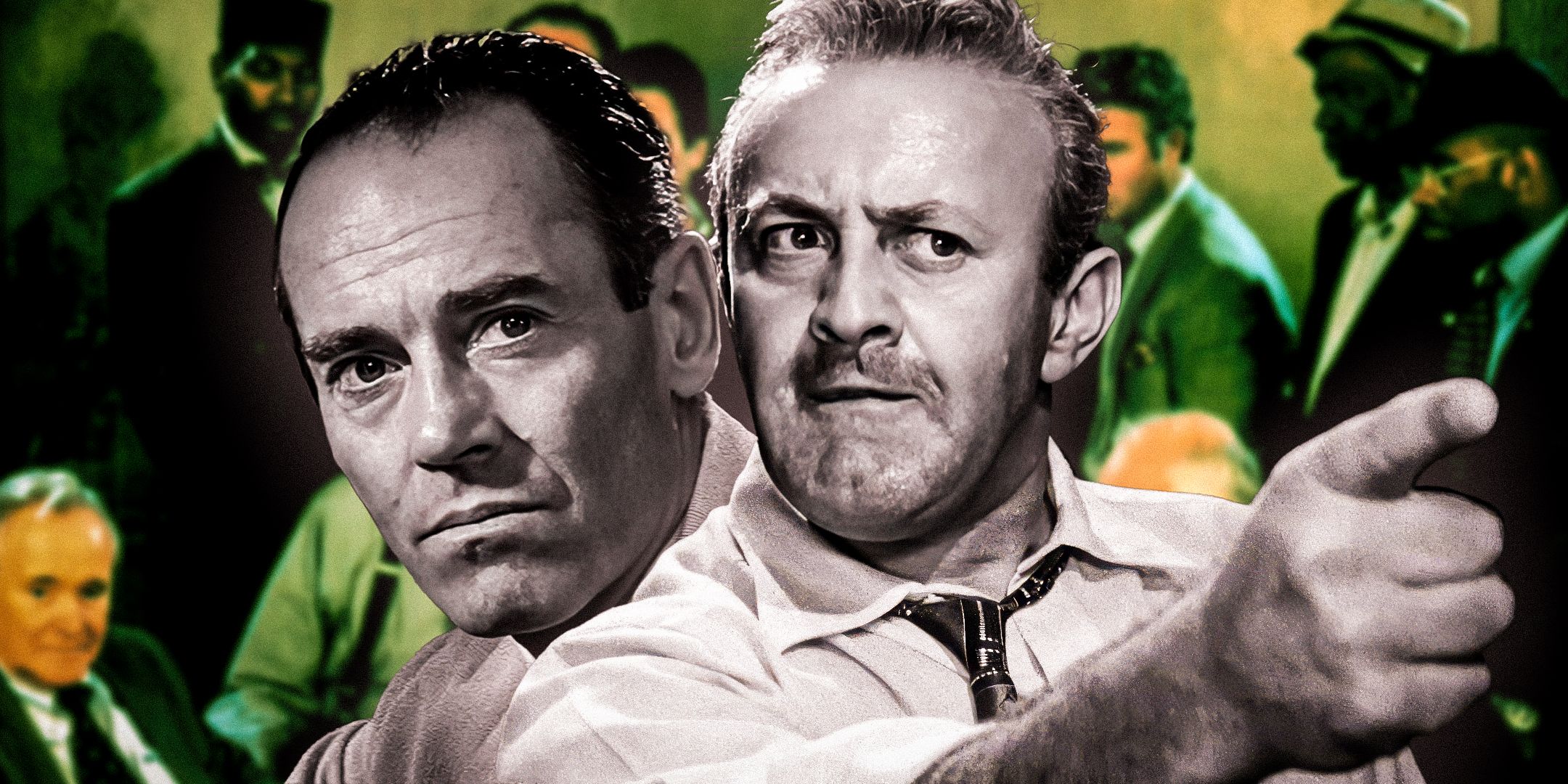
You’ve seen the shot. Henry Fonda, dressed in a crisp white suit that somehow stays unwrinkled while every other man in the room is melting into a puddle of sweat. He stands by the window. He looks out at the New York skyline, calm, while eleven other guys are basically ready to tear his head off for delaying their dinner.
It’s one of the most famous images in cinema. But honestly? The story behind Henry Fonda 12 Angry Men is a lot messier—and more interesting—than just a guy in a white suit standing up for what’s right.
The gamble that almost broke Fonda
People think of this movie as an effortless masterpiece. It wasn't. Back in 1957, Henry Fonda wasn't just the star; he was the guy putting his neck on the line as a first-time producer. He’d seen Reginald Rose’s teleplay on CBS and became obsessed. He teamed up with Rose to get it made, but Hollywood wasn't exactly biting.
Who wanted to see twelve middle-aged dudes shouting in a single room for 90 minutes?
United Artists finally gave them a tiny budget of $340,000. To put that in perspective, even back then, that was peanuts. Fonda didn't even take a salary. He worked for "deferred payment," which is a fancy way of saying he’d get paid only if the movie actually made money.
Spoiler alert: It didn't.
When it first hit theaters, the film bombed. United Artists made the weird decision to open it in a massive 4,600-seat theater in New York. On opening night, only a few rows were filled. Fonda was devastated. He famously hated seeing himself on screen anyway, but seeing his passion project tank must have stung. It only became a "classic" years later through television reruns and its use in law schools.
Why Juror 8 isn't actually a hero (according to some)
We’re conditioned to see Juror 8 as the ultimate hero. The architect. The man of reason. But if you talk to actual legal experts, they’ll tell you he’s a nightmare.
In a real court of law, what Juror 8 does would probably cause a mistrial. You know that famous scene where he slams a second "unique" switchblade into the table?
- It's dramatic.
- It's iconic.
- It's totally illegal.
Jurors are supposed to decide a case based only on the evidence presented in court. By going out and buying his own knife to prove a point, Fonda’s character committed juror misconduct. He brought in outside evidence. In 2026, if a juror did that and posted about it, the judge would throw the whole case out before you could say "reasonable doubt."
Yet, we love him for it. We love him because he represents the "minority of one." He isn't saying the kid is innocent. He’s just saying, "I don't know." That’s a powerful distinction. Most of the other jurors are voting based on their lunch plans or their deep-seated racism. Juror 8 is the only one who actually takes the "burden of proof" seriously.
The "sweaty" direction of Sidney Lumet
This was Sidney Lumet’s first feature film. He was a TV guy. But he had this brilliant, kinda subtle trick for making the room feel smaller as the movie goes on.
In the beginning, the camera is positioned above eye level and uses wide-angle lenses. This makes the room look normal. As the heat rises and the arguments get meaner, Lumet lowered the camera and switched to longer lenses. This literally crowds the actors. The ceiling starts to feel like it’s pressing down on their heads.
By the end of the film, you’re basically nose-to-nose with Lee J. Cobb as he’s having a breakdown.
A cast of legends (and one "Nobody")
Fonda was the only real "star," but the ensemble he pulled together was insane. You had:
- Lee J. Cobb (Juror 3): The literal personification of repressed fatherly rage.
- E.G. Marshall (Juror 4): The cold, logical stockbroker who only changes his mind when he starts to sweat.
- Jack Warden (Juror 7): The guy who just wants to go to a baseball game. Honestly, we’ve all been that guy in a meeting that’s gone on too long.
Interestingly, none of the characters have names. They are just numbers. It’s only in the very last few seconds, on the courthouse steps, that Fonda’s character reveals his name is Davis. It’s a tiny moment of humanity after 90 minutes of being a "cog in the machine."
The real-world impact
Believe it or not, this movie actually changed how people viewed the legal system. In the UK, it’s often cited as one of the reasons they eventually moved away from unanimous jury requirements in certain cases—the fear was that one "stubborn" person could hold the whole system hostage.
In India, the movie (and the real-life Nanavati case) contributed to the total abolition of the jury system. Lawmakers there saw how easily a group could be swayed by emotion rather than hard facts.
What you can learn from Juror 8
If you’re looking for a "takeaway" from Henry Fonda 12 Angry Men, it isn't about the law. It’s about the art of persuasion.
Fonda doesn't win by yelling. He wins by asking questions. He uses a technique called "the soft sell." Instead of telling people they’re wrong (which makes them dig their heels in), he says things like, "It’s possible," or "I just want to talk."
He makes it safe for the other jurors to change their minds without losing face. That’s a lesson that works just as well in a corporate boardroom as it does in a sweaty jury room in 1957.
Actionable insights for your next rewatch
If you’re going to watch it again, pay attention to these three things that most people miss:
- The Fan: Watch when the fan finally starts working. It happens right as the "cool" logic of Juror 8 starts to take over the room.
- The Glasses: Notice how Juror 4 (the logical one) only concedes when he is forced to take off his glasses to wipe away sweat. It’s the moment his "vision" is finally challenged.
- The Knife: Look at the faces of the other jurors when Fonda pulls out the second knife. That’s the exact moment the power dynamic shifts, and it’s all told through silent reaction shots.
The movie is nearly 70 years old, but it feels like it could have been filmed yesterday. That’s the magic of Fonda. He wasn't just an actor; he was the moral compass of an era.
To really appreciate the craft, watch the film specifically focusing on how Fonda uses silence. Unlike Lee J. Cobb, who fills the room with noise, Fonda uses the spaces between words to let the other jurors' own guilt and bias hang in the air. This "active listening" is what ultimately breaks the deadlock. If you want to dive deeper into the technical side, look up Sidney Lumet's book Making Movies, where he breaks down the specific lens changes used to create the claustrophobia of the set.