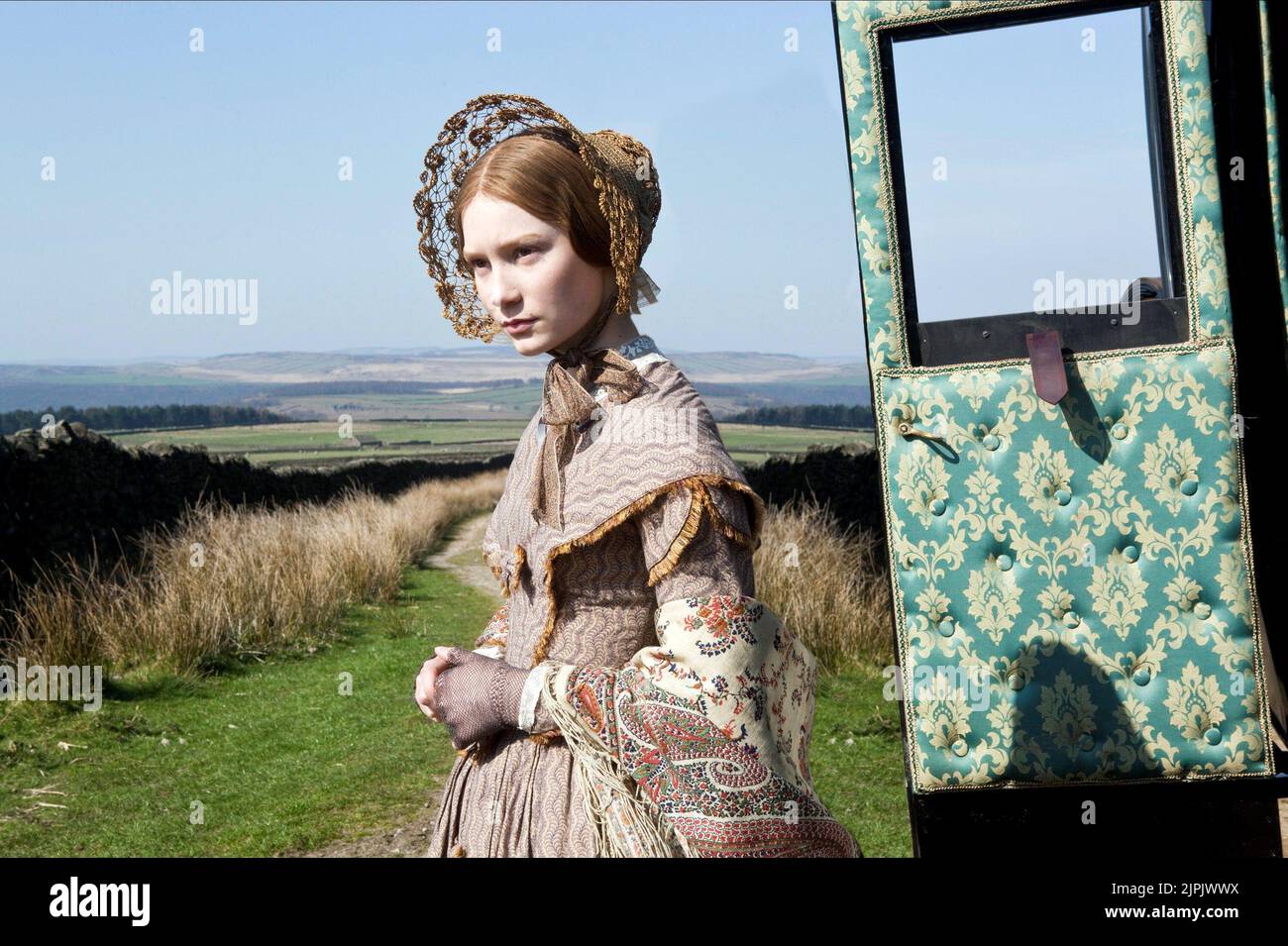
You know that feeling when you watch a movie and realize the director actually read the book? Not just skimmed it for the plot beats, but really sat with the weird, uncomfortable energy of the prose? That’s basically the 2011 version of Jane Eyre starring Mia Wasikowska.
It’s been over a decade since Cary Fukunaga released this thing, and honestly, it’s still the gold standard. Most adaptations of Charlotte Brontë’s masterpiece treat it like a dusty museum piece or a Hallmark card with better costumes. But Wasikowska? She brought something quiet and almost terrifyingly sharp to the role. It wasn't about being a "period drama queen." It was about a girl who had been kicked by the world since she was five and decided she wasn't going to break.
The "Plain" Problem: How Wasikowska Nailed the Casting
Most people get the casting of Jane wrong. In the book, Jane is explicitly "plain." She’s small. She’s "obscure." Usually, Hollywood ignores this and casts a supermodel in a bonnet. While Wasikowska is obviously a striking person, she has this incredible ability to look... well, unremarkable when she wants to.
Fukunaga mentioned in interviews that he loved the "sense of observation in her eyes." He didn't want theatricality. He wanted a girl who looked like she was constantly calculating her next move because survival depended on it.
- Age Matters: Wasikowska was 21 during filming, which is way closer to the book's Jane (who is 18 during the Thornfield years) than the 30-somethings we usually see.
- The Vibe: She’s stoic. Kinda chilly, actually. But that makes the moments where she cracks—like that "soulless and heartless" speech—hit like a freight train.
- The Look: Costume designer Michael O'Connor actually put her in era-appropriate knickers and multiple petticoats. He didn't know if Fukunaga was going to film her running or sitting, and he wanted the silhouette to be perfect. Mia wore the whole thing, corset and all, which she said actually helped her find Jane’s rigid posture.
Why the Flashback Structure Actually Worked
If you’ve seen the movie, you know it doesn’t start at the beginning. Most versions go: Jane is a kid, Jane goes to school, Jane goes to Thornfield. Boring.
Instead, the 2011 film opens with Jane fleeing Thornfield in the middle of a breakdown. She’s sobbing on the moors. It’s raining. It’s miserable. In fact, Wasikowska almost got hypothermia on the second day of shooting because of that rain sequence.
By starting near the end, the movie turns the story into a mystery. We see her rescued by St. John Rivers (played by a very stern Jamie Bell) and then we piece together how she got there through these fever-dream flashbacks. It makes the whole experience feel more psychological. You’re inside her head, not just watching her life happen.
Michael Fassbender and the Alchemy of Rochester
We have to talk about Michael Fassbender. Playing Edward Rochester is a trap. You either go too "grumpy old man" or too "misunderstood hero." Fassbender went for "sexy alligator." That’s how one critic described it, and honestly, it fits.
His Rochester is dangerous. He’s impulsive. He’s also clearly a mess. The chemistry between him and Wasikowska is weirdly modern. They don't flirt; they duel. They sit by the fire and trade barbs that feel like they're being whispered across a century.
One thing the movie famously cut was the "gypsy woman" scene. In the book, Rochester dresses up as a female fortune teller to trick Jane into confessing her feelings. It’s a bizarre, campy moment that Fukunaga decided to scrap. A lot of purists were annoyed, but let's be real: seeing Fassbender in a wig and a shawl might have ruined the moody, Gothic tension they were going for.
The Visuals: Candlelight and Cold Stone
This wasn't a "pretty" movie. It was a tactile one. Cinematographer Adriano Goldman used a lot of natural light. If a scene happened at night, they used candles or the fireplace. It makes Thornfield Hall feel drafty and massive.
They filmed at Haddon Hall in Derbyshire, which is one of the oldest houses in England. It actually looks like a place where a man might hide a "mad wife" in the attic. There’s no Hollywood gloss here. It’s all damp stone, gray skies, and those endless, lonely moors.
What Most People Miss About the Ending
The movie ends abruptly. Some people hate that. In the book, there’s a whole bit where Rochester regains sight in one eye so he can eventually see his firstborn child. It’s a classic Victorian "happy ending."
The film cuts that. It leaves them in the garden, Jane embracing a blinded, broken man. It’s grittier. It suggests that Jane isn't coming back because things are fixed; she's coming back because she is finally his equal. She has her own money, her own family, and her own "uncompromising convictions," as the script calls them.
Actionable Tips for Revisiting the Film
If you’re planning a rewatch or seeing it for the first time, keep these things in mind to get the most out of it:
- Watch the eyes, not the mouth. Wasikowska does 90% of her acting with her micro-expressions. If you're looking for big, dramatic sobbing, you'll miss the nuance.
- Listen to the score. Dario Marianelli (who won an Oscar for Atonement) did the music here. It’s heavy on the violin and feels like it’s mimicking Jane’s heartbeat.
- Notice the framing. Fukunaga often puts the camera right behind Jane’s head. He wants you to see the world as she sees it—guarded and slightly detached.
- Compare it to the 2006 BBC version. If you want the full, four-hour deep dive into every sub-plot, watch the Ruth Wilson version. But if you want the feeling of the book, stick with 2011.
Jane Eyre works because it’s a story about a woman who refuses to settle for a version of love that requires her to lose herself. Wasikowska’s performance isn't just a role; it’s a character study in resilience. It reminds us that being "plain" and "little" doesn't mean you aren't a force of nature.