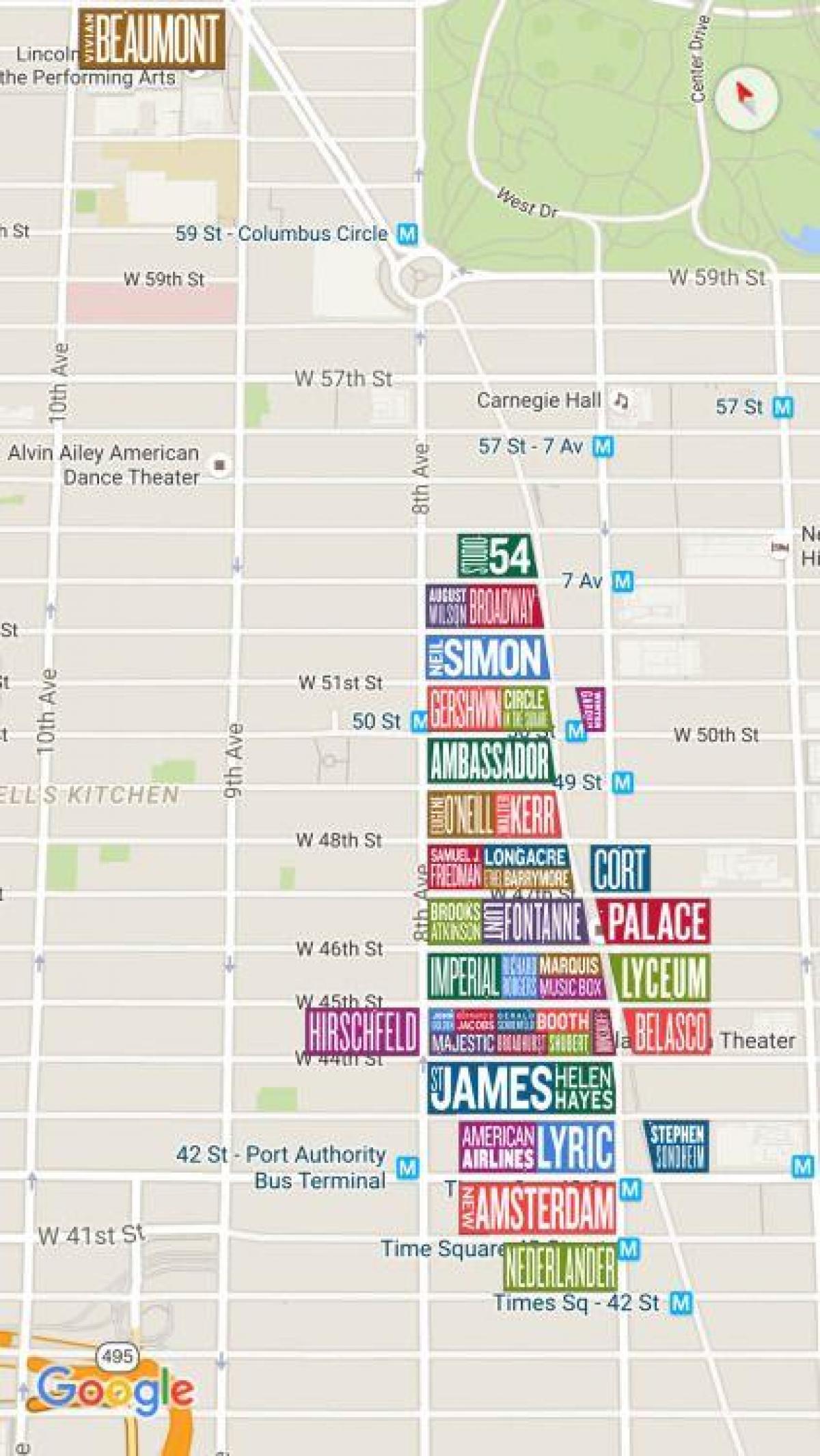
You've probably seen the posters. The neon. The tourists staring up at the flashing screens until their necks hurt. But if you’re actually trying to find a specific theater or just want to understand why this one street feels like the center of the universe, looking at a map of Broadway New York City is a bit like reading a topographical map of a fever dream.
Broadway isn't just a street. It’s an anomaly.
Most of Manhattan is a boring, predictable grid. You have streets running east-west and avenues running north-south. It’s basically a giant graph paper. Then there’s Broadway. It cuts diagonally across the entire island like a rebel who refuses to follow the rules. Because it ignores the grid, it creates these weird, triangular "bowtie" intersections whenever it hits an avenue. That’s why we have Union Square, Madison Square, and the big one: Times Square.
If you're staring at a map right now, you’ll notice the "Theater District" is actually a tiny chunk of this 13-mile-long road.
Where the Magic Actually Happens
Most people think "Broadway" means the whole street. Honestly? If you go to 225th Street in the Bronx, you’re still on Broadway, but you’re definitely not seeing The Lion King there.
The actual Broadway Theater District—the part you probably care about—is a tight rectangle. It generally runs from West 40th Street to West 54th Street, and from Sixth Avenue to Eighth Avenue.
Within these few blocks, you’ll find 41 "Broadway" theaters. Here’s the kicker: only three of them are actually on the street named Broadway. The rest are tucked away on the side streets.
- The Winter Garden Theatre: 1634 Broadway.
- The Broadway Theatre: 1681 Broadway.
- The Palace Theatre: 1564 Broadway.
Everything else? It’s on 44th, 45th, 52nd... you get the idea. This is why a good map is a lifesaver. If you just walk down Broadway looking for the Majestic Theatre, you'll walk right past it because it's actually halfway down 44th Street.
The Great White Way and the "Bowtie"
Why is the map of Broadway New York City so bright? It’s nicknamed the Great White Way. Back in the late 1800s, this was one of the first streets in the U.S. to be fully lit by electric arc lamps.
When you look at the map at 45th Street, you see where Broadway and 7th Avenue cross. This creates the "Bowtie." It’s the heart of Times Square. This is where the TKTS booth is—that big red staircase where you can buy half-price tickets.
Finding Your Way Without Your Phone
If your battery dies (it happens to the best of us), look for Duffy Square. It’s the northern triangle of the Times Square bowtie at 46th Street.
There is actually a massive map embedded in the ground there. It’s called the "Spotlight on Broadway" Map. It’s made of granite and stainless steel, stretching 28 feet long. It shows the locations of all the major theaters. It’s sort of a permanent, low-tech GPS for theater nerds.
What People Get Wrong About the Map
There’s a common misconception that "Broadway" is a quality of the show. Nope. It’s a geographic and capacity-based definition.
- Broadway Theaters: Must have 500+ seats and be in that specific district.
- Off-Broadway: 100 to 499 seats. These are scattered all over the map, from Greenwich Village to the Upper West Side.
- Off-Off-Broadway: Less than 100 seats. These are often in basements, lofts, or repurposed delis.
If you’re looking at a map and see a theater at Lincoln Center (the Vivian Beaumont), you might think it’s too far north to be a Broadway theater. It’s at 65th Street! But it’s the exception to the rule. It’s officially a Broadway house because of its size and contract status, even though it’s a 20-minute walk from the rest of the pack.
Navigating the Side Streets
Most of the "heavy hitter" theaters are clustered on 44th and 45th Streets.
If you walk down Shubert Alley—a famous little pedestrian-only gap between 44th and 45th—you’re basically in the epicenter. You’ve got the Shubert, the Booth, and the Majestic all within spitting distance.
The map can feel crowded here because it is. You’ll have thousands of people spilling out onto the sidewalk at exactly 10:15 PM when the curtains drop. If you’re trying to catch an Uber, don't stay on Broadway. Walk a block or two west toward 9th Avenue or east toward 6th. Your driver will thank you, and you'll actually get home before midnight.
The Northern and Southern Outliers
While the "District" is the main event, the map of Broadway New York City tells a longer story.
Down south, Broadway passes the Flatiron Building at 23rd Street. Further south, it hits Soho and eventually ends at Battery Park at the very tip of Manhattan. This southern part is the oldest. It follows an ancient Native American trail called the Wickquasgeck Trail.
To the north, Broadway keeps going past Columbia University and way up into Inwood. It’s a wild contrast. You go from the hyper-commercial neon of the 40s to quiet, tree-lined residential blocks in the 150s, all on the same road.
Actionable Tips for Your Visit
Don't just wander aimlessly. Broadway is designed to overwhelm you.
- Download a PDF Map: Don't rely on live Google Maps in Times Square. The tall buildings and massive LED screens can actually mess with your GPS signal. It’s a "canyon effect."
- Check the Stage Door: If you want to meet the actors, the stage door is almost never the front door. Look at a satellite map to find the alley or side entrance.
- Use the Subway: The Times Square–42nd St station is the main hub. It connects the 1, 2, 3, 7, N, Q, R, W, and S lines. If you’re coming from the east side, take the S (Shuttle) or the 7 train.
- Walking is Faster: Between 42nd and 50th Street, walking is almost always faster than taking a bus or a taxi. The traffic is legendary for a reason.
Basically, the map of Broadway is a guide to the history of New York itself. It’s the one road that refused to be straightened out. It’s messy, it’s confusing, and it’s exactly where you want to be.
Before you head out, pick one "anchor" spot. Use the TKTS booth or the Father Duffy statue as your "north star." If you can find the red steps, you can find your way to any theater on the list. Just remember to look at the street signs, not just the billboards. The theaters are closer than they look, but they're always hiding just around the corner on the numbered streets.