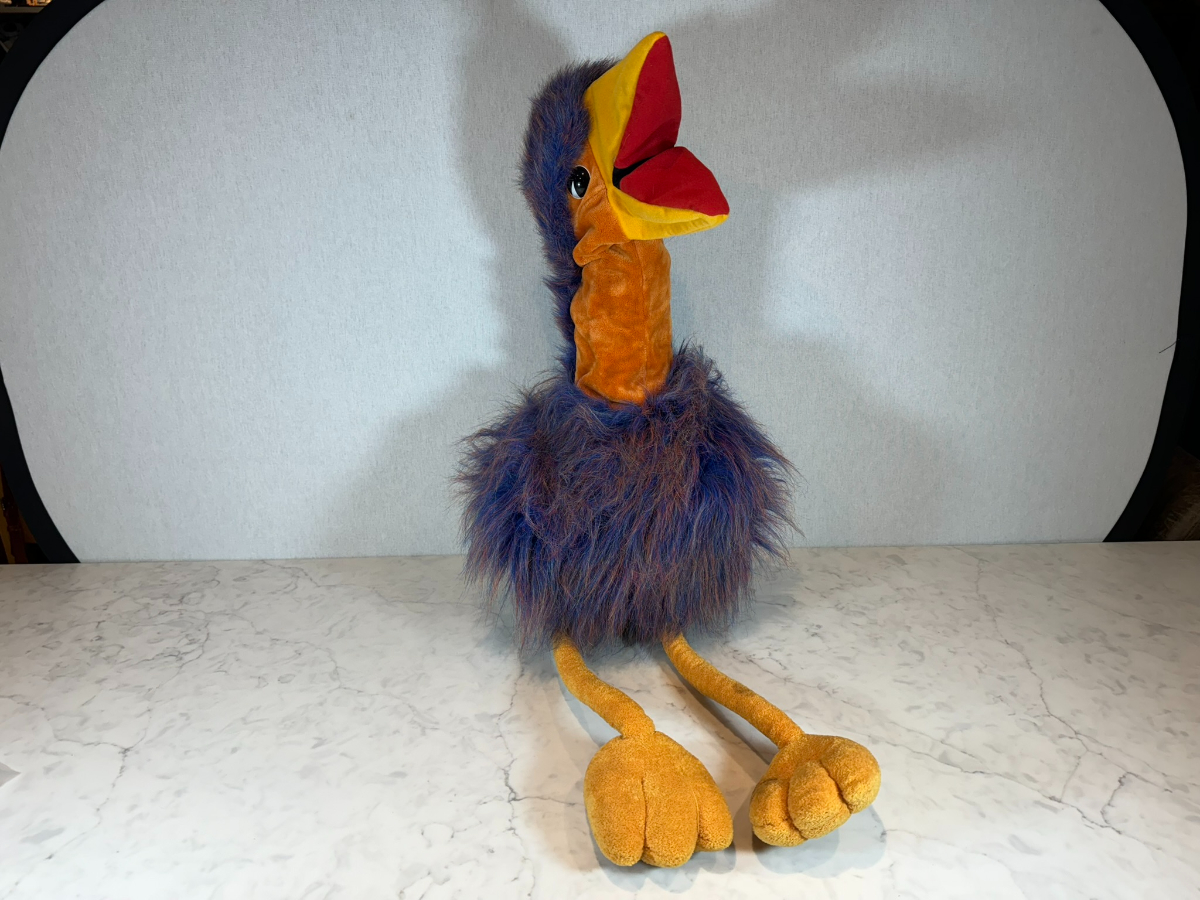
Rod Hull and Emu were basically the original "glitch in the matrix" of British television. If you grew up in the UK or Australia during the seventies or eighties, you probably remember that chaotic, mute, giant bird with the terrifyingly sharp beak and the tendency to destroy expensive studio sets. Honestly, it wasn't just a puppet act. It was a weird, physical, high-stakes performance art piece that eventually led to one of the most famous (and awkward) moments in the history of the talk show.
You’ve likely seen the clip of Emu attacking Michael Parkinson. It’s the one everyone points to. Parkinson, a man who interviewed world leaders and Hollywood royalty with total composure, was literally wrestled to the floor by a man with a puppet on his arm. It was hilarious, but it was also sort of uncomfortable. It broke the "fourth wall" of celebrity interviews before people were even using that term.
The Man Behind the Bird
Rod Hull wasn't some overnight success story who stumbled into a puppet shop. He was born in the Isle of Sheppey, Kent, in 1935. After doing his National Service, he actually moved to Australia to work in television. That’s where Emu was born. He was working as a lighting technician and later a presenter on a children's show called The Channel Nine Show.
He found the puppet in a cupboard. It was just a leftover prop. But Hull saw something in it. He realized that if he never gave the bird a voice, it became more menacing and unpredictable. That’s a key piece of why the act worked. Most ventriloquists try to be "sweet" or clever with their puppets. Rod Hull went for pure, unadulterated chaos. He didn't speak for Emu; he just let the bird's beak do the talking.
When he brought the act back to the UK in 1970, appearing on The Royal Variety Performance, the Queen Mother reportedly loved it. That was the seal of approval. Suddenly, Rod Hull and Emu were everywhere. They weren't just for kids; they were a staple of prime-time variety shows.
That Infamous Michael Parkinson Interview
We have to talk about 1976. It is the defining moment of Hull's career, for better or worse.
Michael Parkinson was the king of the "serious" interview. Then Rod Hull walks on with a bird that looks like it’s made of old carpets. Within minutes, Emu is snapping at Parkinson’s nose. Then the bird lunges. Parkinson is knocked off his chair. He’s on the floor, legs in the air, trying to maintain some dignity while a puppet relentlessly pecks at his crotch and face.
The audience was howling. But if you look at Parkinson’s face, he’s actually quite annoyed. Years later, he famously complained that the Emu incident overshadowed his entire career. He’d interviewed Orson Welles and Muhammad Ali, but people only wanted to talk about the time he got beat up by a puppet.
Why did people love the mayhem?
It was a total subversion of authority. Television in the 70s was often quite stiff and formal. Rod Hull and Emu represented a complete breakdown of that order. You never knew if the guest on the sofa next to them—whether it was Billy Connolly or a member of the royal family—was going to get "attacked."
It was physical comedy in its purest, most aggressive form. Rod Hull was incredibly strong, too. People forget that. To make Emu look like it was dragging Rod around, Rod had to actually use his own body weight to create the illusion of the bird's strength. It was physically demanding work that left him exhausted after every show.
The Darker Side of Fame and the Final Years
Behind the scenes, things weren't always as bright as the stage lights. Rod Hull struggled with being pigeonholed. He was a talented guy who wanted to be known for more than just the bird, but the public wouldn't let him. They only wanted Emu. It’s a classic case of the creation eclipsing the creator.
By the late 80s and 90s, the variety show era was dying. People wanted something different. Hull’s career started to decline. He faced significant financial troubles, including a massive tax bill that led to him losing his Tudor mansion, Harold Park. It’s a tragic arc—from being the most sought-after act in the country to living in a small cottage, struggling to make ends meet.
The end came in 1999. It was a weird, sad accident. Hull was trying to fix the TV aerial on his roof so he could watch a football match. He slipped and fell. He was 63. It was a shock to the industry and to the millions of people who grew up with him. It felt like a very "normal" end for a man who had spent his life doing things that were anything but normal.
Understanding the Legacy of Rod Hull and Emu
If you look at modern comedy, you can see the DNA of Rod Hull in performers like Sacha Baron Cohen or Eric André. It’s that "confrontational" humor. The idea of putting a guest in a situation where they don't know the rules.
Hull wasn't just a puppeteer; he was a pioneer of the "cringe" and "anarchy" genres. He showed that you could take a simple prop and turn it into a cultural phenomenon just through sheer commitment to the bit. He never broke character. Emu was always real to him, or at least, he acted like it was.
Common Misconceptions
- Emu was a robot: Nope. Just Rod’s arm and a lot of physical acting.
- Rod Hull hated the bird: Not exactly, but he felt trapped by it. He acknowledged it gave him everything, but it also took away his identity as a solo performer.
- The Parkinson attack was staged: It absolutely wasn't. Parkinson's reaction was genuine shock.
What You Can Learn From the Emu Era
There’s a reason we still talk about these clips fifty years later. They represent a time when TV felt "live" and dangerous. In a world of highly polished, PR-managed media, the raw energy of a man wrestling a talk show host is refreshing.
If you're interested in the history of British entertainment, look past the puppet. Look at the timing. Look at how Rod Hull used silence. He never needed a catchphrase because the bird's behavior was the punchline. It's a masterclass in physical theatre, even if it's disguised as a children's act.
How to Explore This History Further
- Watch the archives: Search for the 1976 Parkinson episode, but also look for Rod Hull's appearance on The Hudson Brothers Razzle Dazzle Show to see how he performed for US audiences.
- Read the biography: The Man with the Emu by Rod Hull (his autobiography) gives a really honest look at the highs and lows of his career.
- Visit the sites: While Harold Park is now a private residence, the town of Sheerness still remembers its most famous son with various local tributes.
The story of Rod Hull and Emu is a reminder that sometimes the simplest ideas—a mute bird and a lot of energy—are the ones that stick with us forever. It was chaos. It was brilliant. It was uniquely British.