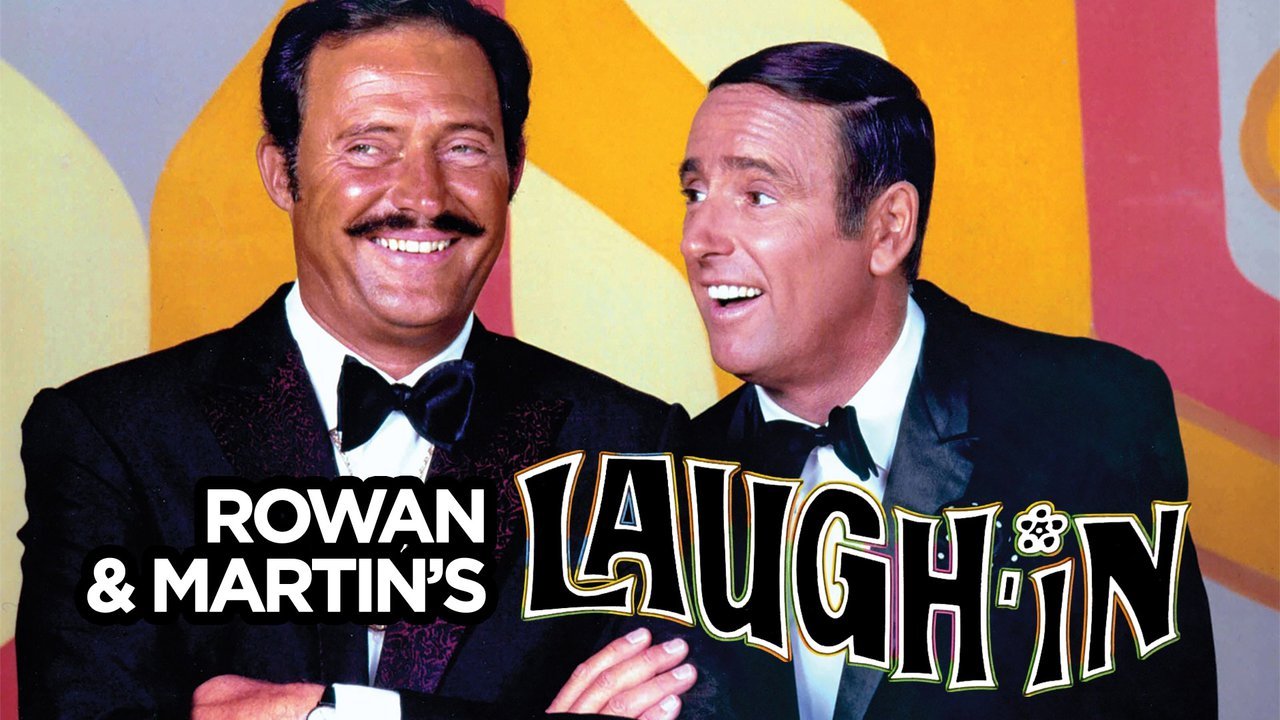
If you were sitting in front of a wood-paneled TV set in 1968, your world probably felt like it was splitting at the seams. You had the Vietnam War on one channel and civil rights protests on the other. Then, suddenly, there was this psychedelic explosion of neon colors, frantic editing, and a girl in a bikini covered in body paint.
That was Rowan and Martin’s Laugh-In.
It wasn't just a variety show. Honestly, it was more like a fever dream that someone decided to broadcast to 50 million people. Hosted by the tuxedo-clad duo of Dan Rowan and Dick Martin, the show basically took the rulebook for television comedy and threw it into a blender.
The Chaos That Captured America
Before this show, TV was slow. You had "The Ed Sullivan Show" where a guy might spin plates for five minutes. Rowan and Martin’s Laugh-In changed the tempo. The producers, George Schlatter and Ed Friendly, used a "rapid-fire" editing style. Sometimes a joke lasted three seconds. If you blinked, you missed a punchline.
It was frantic. It was messy. People loved it.
The show premiered on NBC on January 22, 1968. It was supposed to be a one-time special, but the ratings were so insane that the network had to turn it into a series. For the first two seasons, it was the number one show in the United States. Think about that. In a year as heavy as 1968, the most popular thing in the country was a show where people jumped out of holes in a "Joke Wall" to tell corny puns.
The Catchphrases You Still Hear Today
You’ve probably heard someone say "You bet your sweet bippy" or "Sock it to me" without even knowing where it came from. Those weren't just lines; they were cultural currency.
- "Sock it to me": Usually followed by Judy Carne getting doused with a bucket of water.
- "Here come de judge": A bit borrowed from Pigmeat Markham that became a national obsession.
- "Verrry interesting": Arte Johnson’s German soldier character, peering through bushes.
- "Look that up in your Funk & Wagnalls": A reference to a dictionary that almost nobody actually owned but everyone joked about.
The "Bippy" thing? No one really knew what a bippy was. Dick Martin once hinted it was a euphemism for your rear end, but the vagueness was part of the joke. It was suggestive enough to be funny but clean enough for the 1960s censors.
The Night Richard Nixon Said "Sock It To Me?"
This is the part that sounds like historical fiction, but it’s 100% real. In September 1968, Richard Nixon—a man not exactly known for his sparkling sense of humor—appeared on the show.
He stood there, looking stiff as a board, and asked, "Sock it to me?"
It was only a few seconds of footage, and it reportedly took six takes because he kept sounding too angry. But it worked. It "humanized" him. His opponent, Hubert Humphrey, was offered the same chance but turned it down because he thought it was undignified.
Some political historians actually argue that those five seconds on Rowan and Martin’s Laugh-In helped Nixon win the election. It showed he could take a joke, or at least pretend to.
A Factory for Superstars
The cast wasn't just a group of actors; it was a launchpad.
Goldie Hawn started as the "dizzy blonde" who couldn't remember her lines. She would giggle, look at the camera, and the audience would melt. She won an Oscar for Cactus Flower while she was still technically on the show.
Then you had Lily Tomlin. She brought characters like Ernestine, the snorting telephone operator, and Edith Ann, the little girl in the oversized rocking chair. Without Rowan and Martin’s Laugh-In, we might never have had the career of one of the greatest character actresses in history.
The ensemble was massive:
- Ruth Buzzi (the cranky Gladys Ormphby)
- Arte Johnson (the man of a thousand voices)
- Henry Gibson (the soft-spoken poet holding a giant flower)
- Jo Anne Worley (the loud, pearl-clutching powerhouse)
- Gary Owens (the announcer with his hand forever cupped over his ear)
Why It Eventually Faded
By 1973, the world had changed again. The "happening" vibe of the late 60s felt a little dated. The show relied heavily on topical humor, which is great for ratings but terrible for syndication. If you watch an old episode now, half the jokes are about local California politicians or specific 1969 news events that nobody remembers.
Also, the cast started leaving. When Goldie and Lily moved on to bigger things, the show lost its "it" factor. It was canceled in May 1973 after 140 episodes.
But its DNA is everywhere. If you like Saturday Night Live, you're looking at the direct descendant of Laugh-In. The "Weekend Update" segment on SNL? That basically started as the "Laugh-In Looks at the News." The quick-cut editing you see in TikToks or modern commercials? You can trace that straight back to the Burbank studios where Dan and Dick stood in their tuxedos.
How to Experience the Legacy Today
If you want to understand why your parents or grandparents still quote this show, you don't have to hunt down dusty VHS tapes.
- Watch the Richard Nixon clip: It’s on YouTube. It’s awkward, fascinating, and a weirdly important moment in American political history.
- Check out Lily Tomlin’s early work: Look for "Ernestine" sketches. The satire about the phone company monopoly is still surprisingly sharp.
- Look for the "Joke Wall" finales: This was the "curtain call" of the show. It’s a masterclass in how to deliver 20 jokes in 60 seconds.
Rowan and Martin’s Laugh-In was a bridge. It connected the old world of vaudeville to the new world of counterculture. It was silly, it was loud, and for a few years, it was the only thing everyone in America could agree to laugh at.
To dig deeper into the 1960s TV revolution, look up the history of the Smothers Brothers. They were the "edgy" counterparts to Laugh-In and faced much heavier censorship for their political stances. Comparing the two shows gives a perfect picture of the tightrope performers had to walk during that era.