You walk out of the Sagrada Família metro station and it hits you. Not just the size, though it's massive, but the sheer weirdness of it. It looks like a giant, melting sandcastle or maybe something grown in a lab rather than built by stonemasons. People call it the Sagrada Família, and honestly, most of what you’ve heard about it being "unfinished" barely scratches the surface of why this place is so polarizing.
It’s been under construction for over 140 years.
That’s longer than it took to build the Great Pyramids. It’s longer than the Great Wall of China's most intensive phases. When Antoni Gaudí took over the project in 1883, he knew he wouldn’t see it finished. He actually joked that his "client" (meaning God) wasn't in a hurry. But 2026 was supposed to be the big year—the centenary of Gaudí’s death. Now? Things are a bit more complicated.
The Sagrada Família and the 2026 Question
Everyone wants to know when the cranes are finally coming down. For a long time, the official word was 2026. Then the world stopped in 2020, tourism revenue—which literally pays for every single brick—evaporated, and the timeline shifted.
The main Tower of Jesus Christ is still on track for 2026. That’s a big deal. When that central spire is finished, the Sagrada Família will officially become the tallest church in the world, standing at 172.5 meters. Gaudí was very specific about that height; he wanted it to be exactly one meter shorter than Montjuïc hill because he believed man-made work should never surpass the work of God.
But "finished" is a relative term here.
While the towers might be done soon, the decorative work on the Glory Facade—the main entrance—could easily stretch into the 2030s. There’s also the massive headache of the grand stairway. To build it according to Gaudí's original vision, the city might have to demolish entire blocks of apartments where people currently live. You can imagine how well that’s going over with the locals.
Why it looks like a forest inside
If you’ve only seen photos of the outside, you’re missing the point. The exterior is dark, gritty, and heavy. The Nativity Facade looks like it was dripped from a giant candle. But the second you step inside, the vibe flips.
Gaudí hated straight lines. He said they didn't exist in nature.
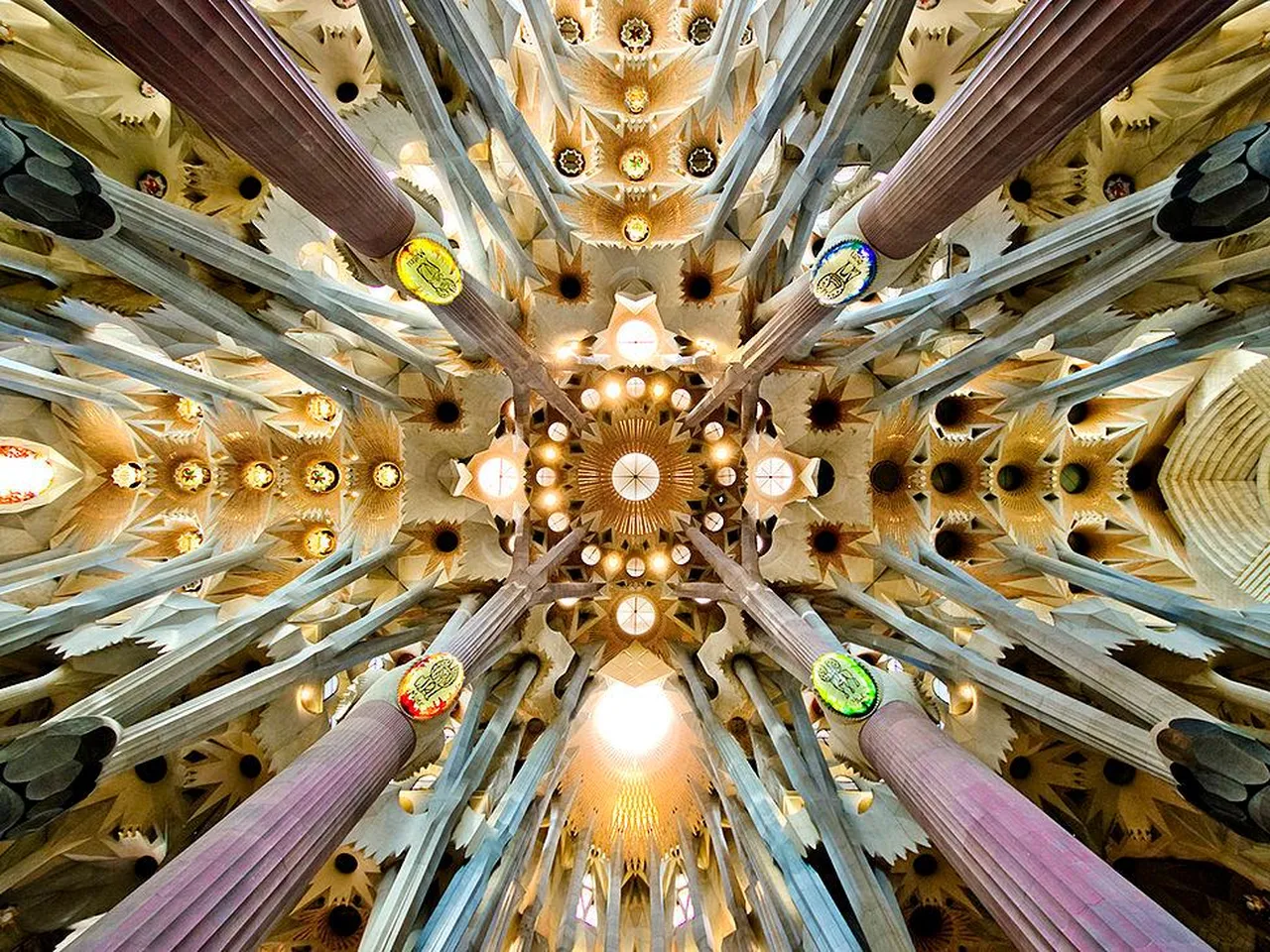
Instead of traditional Gothic pillars that need those bulky flying buttresses on the outside to keep the walls from falling down, Gaudí designed columns that branch out like trees. It’s a forest made of stone. When you look up, the ceiling is a canopy of leaves. It’s not just for aesthetics; it’s a brilliant piece of structural engineering. The weight of the roof is distributed down these "branches," which is why the interior feels so airy and light despite the millions of tons of stone above your head.
The light is the real kicker.
Gaudí didn't just put in stained glass; he orchestrated it. The morning sun hits the eastern side (the Nativity Facade) with cool blues and greens, symbolizing birth and new beginnings. By late afternoon, the western side (the Passion Facade) is flooded with fiery reds and oranges. It’s intense. It feels alive.
The controversy nobody tells you about
There is a huge segment of the architectural world that thinks we should have stopped building the Sagrada Família decades ago.
When Gaudí died after being hit by a tram in 1926, he left behind very few formal blueprints. He preferred 3D models and sketches. During the Spanish Civil War, anarchists broke into his workshop and smashed those models. They even burned his notes.
The people building it today are basically trying to solve a 140-year-old jigsaw puzzle with half the pieces missing.
Architects like Salvador Dalí (yes, that Dalí) argued that the building should have been left as a ruin—a "rotting" monument to a genius. Others argue that the modern materials being used—like reinforced concrete and 3D-printed stone—are a betrayal of Gaudí’s craft. But the foundation, the Junta Constructora, argues that the cathedral is a living thing. They use aeronautical software now to figure out the geometry that Gaudí could see in his head but couldn't easily draw on paper.
How to actually see it without losing your mind
If you’re planning to visit, don't just show up and hope for the best. You’ll be standing in the sun for three hours staring at a "Sold Out" sign.
- Book the first slot of the day. Seriously. By 11:00 AM, the interior feels like a crowded airport terminal. At 9:00 AM, you can actually hear your own footsteps.
- The towers are optional. If you’re claustrophobic, skip them. The elevators take you up, but the walk down is via a tiny, narrow spiral staircase that feels like being inside a snail shell. The views are great, but the real magic is the nave.
- Check the sun. If you want those deep red "sunset" photos inside, book a slot about two hours before golden hour.
The logistics of a 21st-century miracle
It’s easy to forget this is still a functioning church. Pope Benedict XVI consecrated it as a minor basilica in 2010. They hold Mass there, and it’s a place of worship first, a tourist attraction second.
The funding is wild. Not a single cent of government or church money goes into the construction. It is entirely funded by "propietary" donations and ticket sales. This is why the construction speeds up when tourism is booming and grinds to a halt during economic dips. When you buy a ticket, you’re literally paying for a piece of the stone that will be hoisted up next week.
What to look for on the Passion Facade
Most people spend all their time at the Nativity Facade because it’s the only part Gaudí actually finished. But look at the Passion Facade on the other side. It’s harsh. The sculptures by Josep Maria Subirachs are angular and skeletal.
There’s a "magic square" carved into the stone there. It’s a grid of numbers where every row, column, and diagonal adds up to 33—the age of Jesus at his death. It’s these tiny, nerdy details that make the building feel like a secret code waiting to be cracked.
Your next steps for a Barcelona trip
If you're heading to Barcelona, the Sagrada Família is non-negotiable, but you need to see it in context.
- Visit Casa Vicens first. It was Gaudí's first house. Seeing where he started helps you understand how he ended up at the Sagrada Família. It's much quieter and gives you a chance to see his early obsession with nature.
- Download the official app. Use it to buy your tickets directly. Third-party resellers often mark up the price by 20% or 30% for no reason.
- Look at the floor. Most people spend the whole time looking up, but the floor transitions and the way the light hits the stone pavement are equally intentional.
- Walk around the back. There’s a small park (Plaça de Gaudí) with a pond. This is where you get the classic "reflection" shot of the basilica. It’s usually packed with influencers, but if you go early, it’s actually quite peaceful.
The Sagrada Família isn't just a building; it's a statement about time. In an era where we want everything built in six months, there’s something deeply humbling about a project that spans generations. Whether they finish the stairs or not, the "unfinished" nature of it is part of the soul. It’s a monument to the idea that some things are worth waiting for, even if we aren't around to see the final stone.