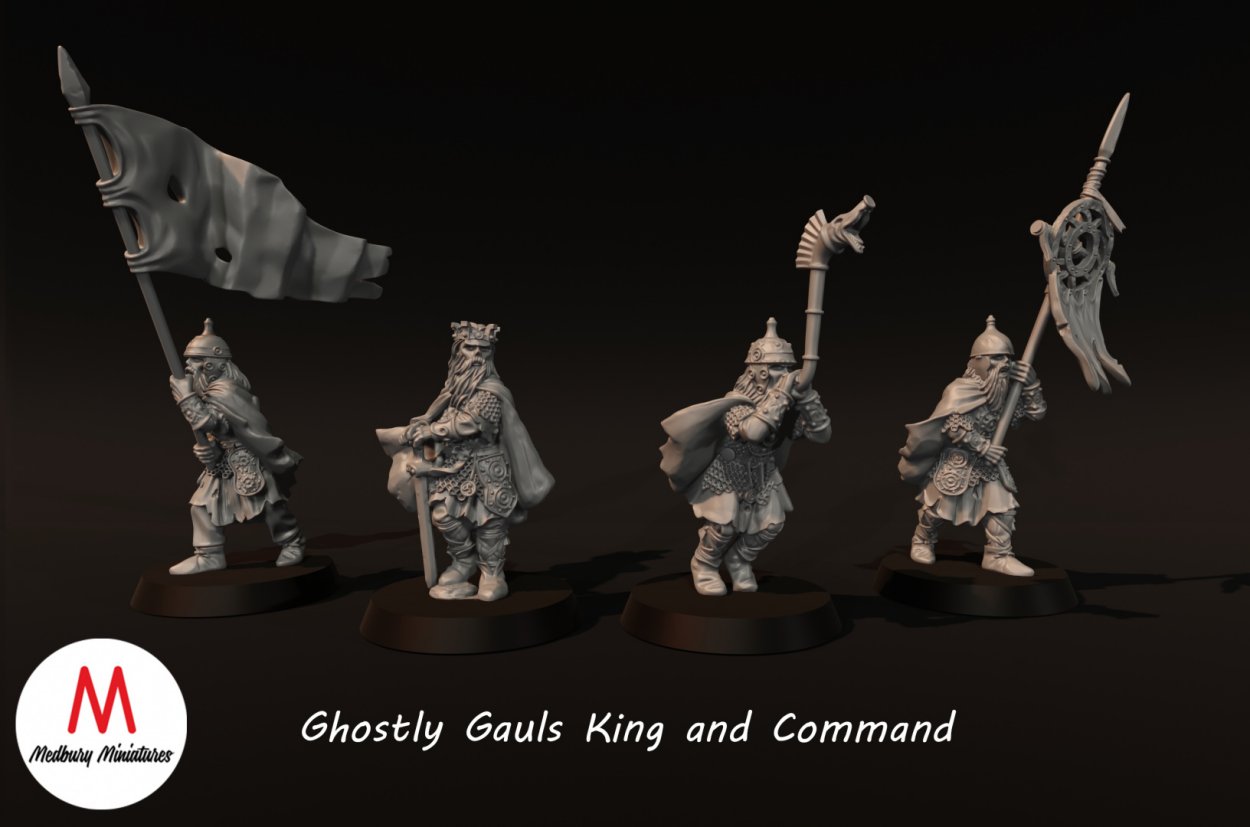
Most people think of the King of the Gauls as some kind of crown-wearing monarch sitting on a golden throne in a stone castle. It wasn’t like that. Not even close. If you’ve ever seen the statues in France or played a strategy game involving the Roman Empire, you’ve seen him: Vercingetorix. He’s the guy with the flowing hair and the defiant stare.
But here is the thing. Calling him a "king" is technically a bit of a stretch, even if Caesar used the term. Gaul wasn’t a country. It was a chaotic, sprawling mess of independent tribes who spent half their time stabbing each other over cattle and prestige. Vercingetorix didn't inherit a throne. He took it. Or rather, he forced a bunch of bickering chieftains to stop fighting each other long enough to fight the biggest war machine the world had ever seen.
He was a nobleman of the Arverni. His father, Celtillus, actually got killed by his own people because he tried to become "King of all Gaul." The Gauls hated the idea of a single ruler. They were obsessed with "libertas"—their word for freedom. So, when Vercingetorix stepped up, he wasn't just fighting Romans. He was fighting his own culture's deep-seated hatred of authority.
The Arverni Rebel Who Outsmarted Caesar
Julius Caesar was a genius. Let’s just be honest about that. But he was also a massive narcissist who wrote his own history books to make himself look good. When he writes about the King of the Gauls in Commentarii de Bello Gallico, he’s doing it to make his own victory seem more impressive.
In 52 BC, the Gauls were done. Caesar had been stomping around their territory for years, taking grain, enslaving kids, and playing tribes against each other. Vercingetorix realized that no single tribe could win. He was young, probably in his late 20s, and he had a terrifying amount of charisma. He went to his home city of Gergovia, got kicked out by his uncle (who thought he was a troublemaker), went to the countryside, raised a literal army of outcasts, and then came back to kick his uncle out.
That’s how he became the supreme commander. He didn’t use a scepter; he used a sword and a very grim sense of discipline. If you were a soldier and you showed up late to his camp, he might cut off your ear or poke out an eye to send you home as a warning to the others. Brutal? Yeah. But he was trying to build a nation in the middle of a genocide.
The Scorched Earth Strategy
Vercingetorix knew he couldn't beat the Roman legions in a fair fight. Romans were professional killers with better gear. So, he decided to starve them. He ordered the Gauls to burn their own homes.
"Burn it all," he basically told them. Everything. The farms, the villages, the barns. If the Romans can't eat, they can't fight. This was a psychological nightmare for the Gauls. Imagine burning your own life's work just to spite an invader. This strategy almost worked. Caesar’s men were hungry, grumpy, and miles from home.
Then came Avaricum. The Bituriges tribe begged Vercingetorix not to burn their beautiful city. They cried. They pleaded. Vercingetorix gave in, and it was his biggest mistake. Caesar captured the city, and out of 40,000 people inside, only 800 survived the Roman massacre.
Why We Keep Calling Him the King of the Gauls
Strictly speaking, Gaul was divided into three parts—at least that’s what Caesar said. You had the Belgae, the Aquitani, and the Celts (Gauls). Vercingetorix managed to unify most of the central and western tribes. For a few brief months, he was effectively the King of the Gauls because his word was law from the Atlantic to the Rhine.
He actually beat Caesar at the Battle of Gergovia. People forget that. Caesar, the man who would eventually rule Rome, had to retreat. Vercingetorix used the high ground and local knowledge to humiliate the Roman legions. It was the peak of Gallic resistance. For a moment, it looked like Rome might actually lose.
The Nightmare at Alesia
Everything came down to a hilltop town called Alesia. Vercingetorix retreated there with about 80,000 men. Caesar did something insane. He built a wall around the city to starve them out. Then, when he heard a massive Gallic relief army was coming to rescue Vercingetorix, he built another wall facing outward.
The Romans were in a donut of stone and wood.
The conditions inside Alesia were horrific. They ran out of food. Vercingetorix had to make the gut-wrenching decision to send out the "useless mouths"—the women, children, and elderly—so the soldiers could eat. But the Romans wouldn't let them through their lines. These people literally starved to death in the "no man's land" between the two walls while both armies watched.
When the relief army finally arrived, it was a mess. They weren't coordinated. Vercingetorix attacked from the inside, the relief army attacked from the outside, and the Romans... they just held. Mark Antony and Labienus (Caesar’s top guys) managed to plug the gaps.
The Surrender and the Myth
The scene of the surrender is legendary. Plutarch describes Vercingetorix putting on his best armor, grooming his horse, and riding circles around Caesar’s throne before throwing his weapons at Caesar’s feet without saying a word.
Was it that dramatic? Probably not. It was likely a very tired, very hungry man realizing his people were going to be slaughtered if he didn't give up. Caesar kept the King of the Gauls in a dark Roman dungeon (the Tullianum) for six years. Six years in a hole in the ground. They finally paraded him through the streets of Rome during Caesar's triumph and then strangled him to death.
Why does this matter in 2026?
We live in an era of "strongman" politics and shifting national identities. Vercingetorix represents the ultimate underdog. He wasn't a hero in the modern sense—he was a warlord—but he was the first person to ever imagine "France" as a single entity.
French emperors like Napoleon III obsessed over him. They built giant statues of him. They wanted to use him as a symbol of French unity. It’s kinda ironic because Vercingetorix lost. He failed. But in losing, he became a martyr that defined a culture for 2,000 years.
Sorting Fact from Fiction
- Did he wear a winged helmet? No. That’s Asterix comic book stuff. He likely wore a high-quality Gallic "Coolus" or "Montefortino" style helmet, probably made of bronze or iron.
- Was he a king? Not by blood. He was a "Vergobret" or a supreme military commander. The title "King of the Gauls" was a Roman label used to simplify things for a Roman audience.
- Did he almost win? Honestly, yes. If the relief army at Alesia had been more disciplined, Caesar’s career would have ended in a ditch in central France.
Historians like Christian Goudineau have spent decades peeling back the layers of Roman propaganda to find the real man. What we find is someone incredibly modern: a PR expert, a logistics nerd, and a guy who knew that you can't win a war without a shared story.
How to Explore the Legacy of Vercingetorix Today
If you’re interested in the real history of the King of the Gauls, don't just watch movies. Go to the sources and the sites.
- Visit MuséoParc Alésia: It’s in Alise-Sainte-Reine, France. They have reconstructed the Roman siege works. Standing there makes you realize how terrifying those walls actually were.
- Read "The Conquest of Gaul" with a grain of salt: It’s Caesar’s memoir. It’s like reading a CEO’s LinkedIn post about how great they are, but it’s the best primary source we have.
- Check out the Arverni coinage: Look at the coins Vercingetorix minted. He put his name on them. That was a huge deal back then—it was his way of saying, "I’m in charge now."
- Look into the Archaeological finds at Gergovia: Recent digs have shown just how advanced Gallic urban planning was. They weren't "barbarians" living in huts; they had complex drainage, industrial zones, and massive fortifications.
The story of the King of the Gauls isn't just about ancient battles. It’s about how a group of people who had nothing in common found a reason to stand together. Even if they lost, that idea of unity changed the map of Europe forever. If you want to understand France, or even the concept of resistance against a superpower, you have to start with the man who rode his horse in circles around Julius Caesar.