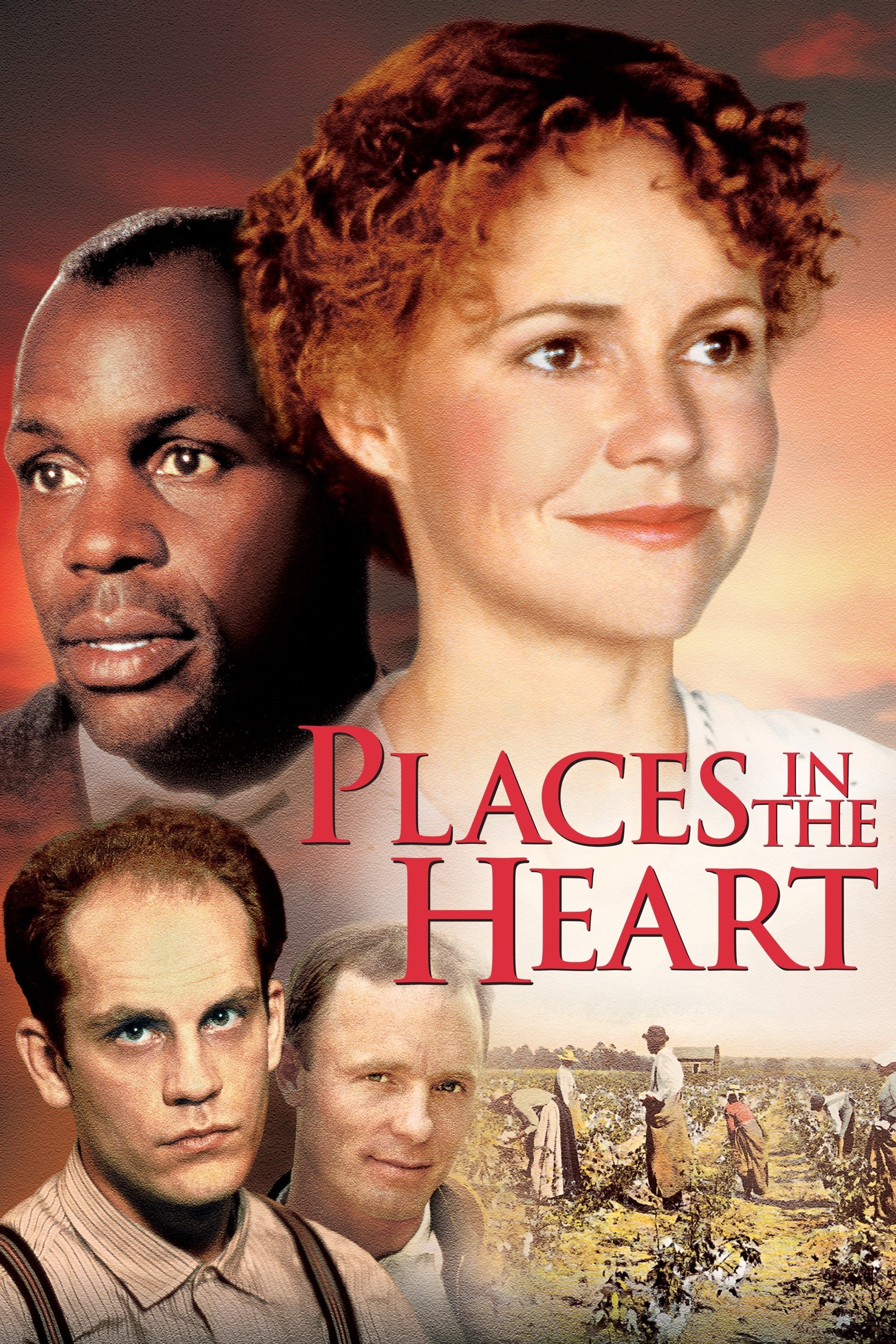
The year was 1984. Cinema was undergoing a weird, messy transition. While kids were lining up for Ghostbusters and Indiana Jones, a quiet, dusty, brutally honest film called Places in the Heart sneaked into theaters and basically wrecked everyone. It wasn't flashy. It didn't have special effects. It just had cotton, grit, and a central performance by Sally Field that remains one of the most raw things ever put on celluloid.
Honestly, if you haven't seen it recently, you’ve probably forgotten how visceral it feels. It’s set in Waxahachie, Texas, during the Great Depression. The movie starts with a literal bang—a freak accident that leaves Edna Spalding a widow with two kids, a mountain of debt, and a farm that the bank is dying to snatch away. It’s a story about survival, but not the Hollywood kind where everything is polished and pretty. This is the kind of survival that involves blisters and dirt under your fingernails.
Director Robert Benton didn't just pull this story out of thin air. He grew up in Waxahachie. This was his soul on the screen. He wasn't interested in making a "period piece" that looked like a postcard; he wanted to capture the heat and the desperation of 1935.
What People Get Wrong About the Places in the Heart Movie
A lot of folks categorize this as just another "save the farm" movie. You know the trope. We saw it in The River and Country, which coincidentally came out around the same time. People call them "farm crisis" movies. But Places in the Heart is doing something much weirder and more beautiful than its peers. It’s actually an exploration of grace in a time of systemic cruelty.
The plot kicks off when Edna, desperate to keep her land, takes in a Black itinerant worker named Moze, played by Danny Glover in what might be his best performance. Moze knows everything about cotton. Edna knows nothing. Then comes Mr. Will, a blind boarder played by John Malkovich, who is forced upon her by the bank. It’s this ragtag, accidental family trying to harvest enough cotton to pay the mortgage.
But here is the thing: the movie doesn't shy away from the horrific racism of the 1930s South. It’s uncomfortable. It should be. The Ku Klux Klan isn't some distant threat in this film; they are the neighbors. They are the people sitting in the pews at church. That’s the nuance Benton captures—the terrifying reality that the people who help you during a tornado might be the same people wearing hoods at night.
The Cotton Harvest: A Masterclass in Tension
There is a sequence in the Places in the Heart movie that defines it. The harvest.
Edna needs to get her cotton to the gin first to get a bonus. If she doesn't get that bonus, she loses the house. Watching Sally Field and Danny Glover in those fields is exhausting. You can almost feel the humidity. Benton shot it with this relentless pace. It’s not a "movie" moment; it feels like a documentary of manual labor.
Sally Field famously won her second Oscar for this. Remember her "You like me, you really like me" speech? People mocked it for years. But if you watch her in this film, you realize why the industry was so floored. She plays Edna without a hint of vanity. She’s stubborn, she’s occasionally ignorant, and she’s terrified.
The Ending That Still Sparks Debates
We need to talk about that final scene. If you’ve seen it, you know. If you haven't, stop reading? No, keep reading, because you need to understand why it matters.
The film ends in a church. It’s a communion service. Suddenly, the boundaries of time and death dissolve. Characters who died earlier in the film—including the man whose death started the whole tragedy—are sitting in the pews. They are passing the bread and wine to their enemies.
It’s a surrealist, spiritual masterstroke. In a film that is so grounded in the dirt and the mud, this jump into the metaphysical is jarring. Some critics at the time hated it. They thought it was too "sappy." But they missed the point. Benton was showing a vision of what the world should be—a place where the scars of the Depression and the sins of Jim Crow are healed. It’s not a literal ending. It’s a prayer.
Why Danny Glover’s Moze is the True Heart
While Field got the Oscar, Danny Glover’s Moze is the character that lingers. He is the most capable person in the film, yet he is the most vulnerable because of the color of his skin. The way the movie handles his departure is heartbreakingly realistic. There is no "happily ever after" for Moze in 1935 Texas. He saves the farm, and his reward is having to flee in the middle of the night to avoid being lynched.
It’s a bitter pill. The film refuses to give you the easy out of a "white savior" narrative. If anything, Moze is the savior, and the world isn't good enough to let him stay.
Technical Brilliance Behind the Dust
Nestor Almendros was the cinematographer. The guy was a legend. He worked with Terrence Malick on Days of Heaven, and you can see that influence here. He used natural light whenever possible. The interiors of the Spalding house feel cramped and dim, lit by lanterns and sunbeams.
- The Tornado Scene: This wasn't CGI. They didn't have that in '84. They used practical effects, wind machines, and careful editing to create one of the most terrifying weather events in film history.
- The Soundscape: Listen to the wind. The sound design in Places in the Heart is all about the environment. The creak of the floorboards, the rustle of the cotton plants, the silence of the Texas plains.
How the Film Holds Up in 2026
Watching Places in the Heart now, decades after its release, it feels surprisingly modern. We are still dealing with the same themes: economic instability, racial tension, the struggle of the "outsider."
The film doesn't preach. It just observes.
It shows us that community is something we build out of necessity, often with the people we least expect. It shows us that courage isn't the absence of fear, but the ability to pick cotton until your hands bleed because your children need a roof over their heads.
Actionable Steps for Film Enthusiasts
If you want to truly appreciate this masterpiece, don't just stream it on a tiny phone screen. This is a movie that requires your full attention.
- Watch the "Farm Trilogy": To get the full context of the mid-80s American cinema landscape, watch Places in the Heart alongside The River (Sissy Spacek) and Country (Jessica Lange). You'll see why Benton’s film is the one that actually stands the test of time.
- Research Waxahachie's History: The town hasn't changed as much as you'd think. Looking at photos of the town square from the 30s vs. today shows how much of the film's "set" was just the actual town.
- Analyze the Communion Scene: Watch the final five minutes three times. Once for the dialogue, once for the faces of the people in the pews, and once for the music. It’s a lesson in thematic filmmaking.
- Compare to 'To Kill a Mockingbird': Both deal with the South, childhood, and injustice. But while Mockingbird is seen through a child's eyes, Places in the Heart is the adult's perspective—where the consequences are much more permanent.
The Places in the Heart movie isn't just a relic of the 80s. It’s a piece of American folk art. It’s messy, it’s painful, and it’s ultimately about the tiny, fragile moments of connection that keep us human when the world is trying to break us. Go watch it again. Bring tissues. You'll need them.