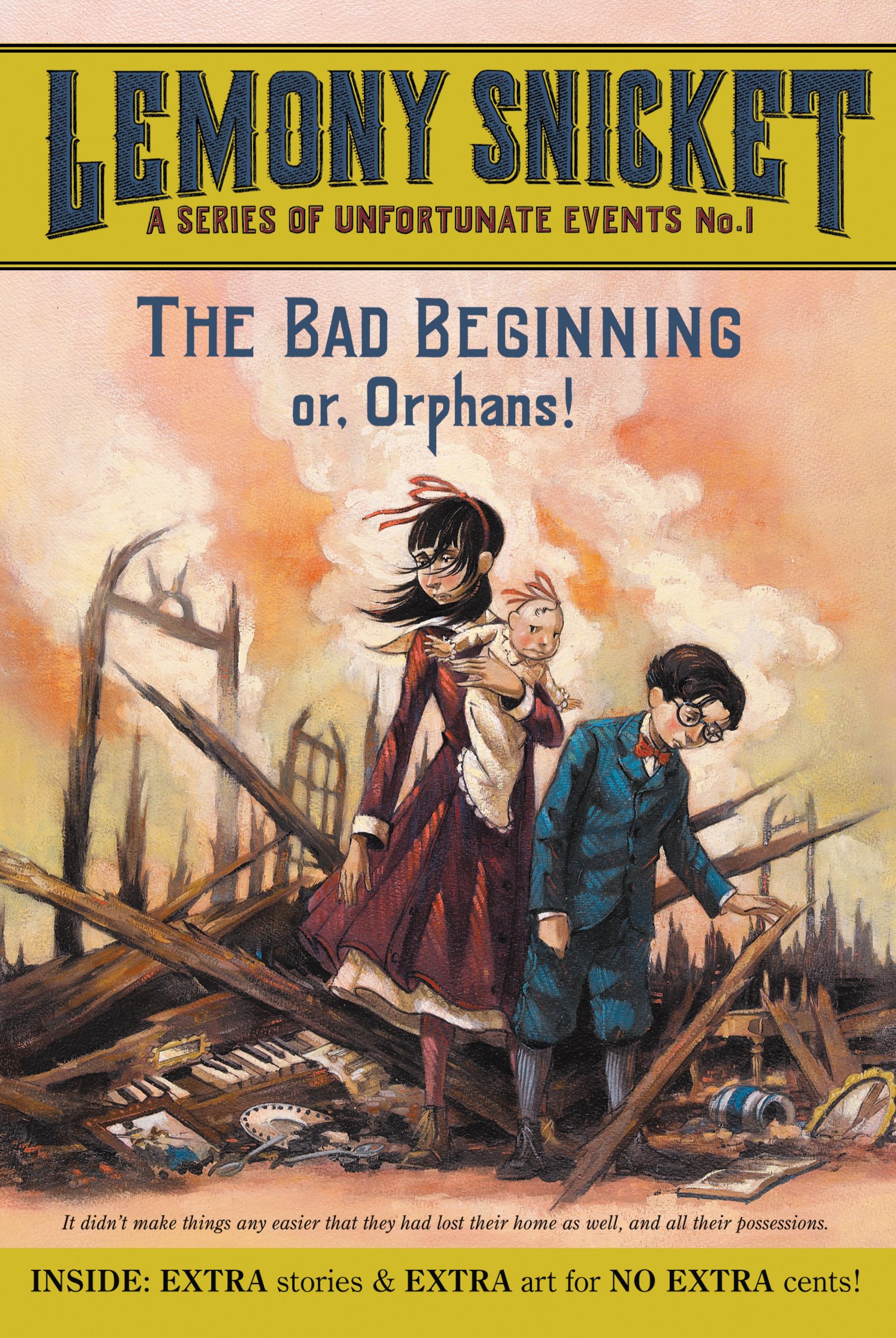
The Baudelaire orphans never had a chance. If you grew up in the early 2000s, you probably remember that specific, gloomy feeling of picking up a book with a frayed, deckle-edge spine and a warning on the back telling you to put it down immediately. It was reverse psychology at its finest. The Bad Beginning didn’t just launch a series; it fundamentally shifted what we thought "children’s literature" was allowed to be. It was mean. It was unfair. It was brilliant.
Lemony Snicket—the pen name of Daniel Handler—didn't write a story about magic schools or talking animals. He wrote about a house fire that killed two parents and left three children at the mercy of a theatrical villain named Count Olaf.
Honestly, the plot of The Bad Beginning is almost surprisingly simple compared to the convoluted lore of the later books like The Penultimate Peril. Violet, Klaus, and Sunny Baudelaire are sent to live with a distant relative who is clearly just trying to steal their massive fortune. But the simplicity is where the horror hides. It's a book about gaslighting. It’s a book about how adults often fail to listen to children, even when those children are literally pointing at a murderer.
The Audacity of Count Olaf’s First Impression
Count Olaf is a terrible person. Not "cartoonishly evil" in a way that feels safe, but genuinely unsettling because of his proximity. He isn't a dark lord in a tower; he’s a legal guardian. When we first meet him in The Bad Beginning, he's filthy, he smells, and he has a single eyebrow that spans his entire forehead.
But it’s the slap that sticks with you.
Early in the book, Olaf strikes Klaus across the face. For a middle-grade novel published in 1999, that was a massive "wait, are they allowed to do that?" moment. Most kids' books at the time dealt with bullies at school or misunderstandings with parents. Snicket went straight for physical abuse and the systemic failure of the foster care system. Mr. Poe, the well-meaning but utterly incompetent banker in charge of the Baudelaire estate, is arguably the real villain. His cough is a constant reminder of his inability to actually breathe in the truth of the orphans' situation. He sees the kids' distress as "dramatics" or "confusion."
It’s frustrating to read. You want to scream at the page. That's the point.
Why the "Word Meanings" Weren't Just Filler
One of the most recognizable quirks of Snicket’s writing is his tendency to define words. "A word which here means..." became a cultural touchstone. Some critics at the time thought it was condescending. They were wrong.
Actually, it was a way of leveling the playing field. By defining complex vocabulary like adversity, vicissitudes, or in loco parentis, Handler was giving kids the tools to describe their own suffering. If you know the word for what is happening to you, you have a tiny bit more power over it.
Breaking the Fourth Wall Before It Was Cool
The narrative voice is a character itself. Snicket constantly interrupts the story of The Bad Beginning to talk about his own miserable life, his lost love Beatrice, and the sheer drudgery of his research. This meta-textual approach did something very specific: it created a bond of shared misery between the reader and the author. You weren't just reading a book; you were part of a secret society. You were "in" on the tragedy.
It also served as a buffer. The events of the book are dark—Olaf literally tries to marry a fourteen-year-old girl through a legal loophole disguised as a play—but the dry, absurdist humor of the narrator makes it digestible. Without that voice, The Bad Beginning would just be a depressing case study in child endangerment.
The Gothic Aesthetic and the 19th Century Confusion
Where does this book take place? When does it take place? Nobody knows.
There are cars, but also horse-drawn carriages. There are telegrams, but also advanced mechanical engineering. This "anachronistic" setting makes the world of the Baudelaires feel like a fever dream. It’s a timeless sort of misery. Brett Helquist’s illustrations played a huge role here. His scratchy, gothic art style made the characters look weary. They didn't have the shiny, polished look of Harry Potter or the bright colors of Goosebumps. Everything looked like it was covered in a thin layer of soot.
The influence of Edward Gorey is all over these pages. If you look at the way the house is drawn—the cracked stone, the peeling wallpaper—it tells the story of decay better than the text ever could. Count Olaf’s house is a physical representation of his soul. It’s crumbling, neglected, and full of hidden eyes.
Looking Back: Does It Hold Up?
Reading The Bad Beginning as an adult is a different experience. You realize that the Baudelaires are remarkably competent. Violet is an inventor. Klaus is a researcher. Sunny... bites things (and later becomes a chef, which is a wild character arc if you think about it).
They aren't saved by luck. They aren't saved by a hero. In the climax of the first book, Violet has to use her right hand to sign a marriage contract even though she’s left-handed, just to create a legal loophole. It’s a victory of intellect over brute force.
However, there are valid criticisms. Some find the formulaic nature of the early books—orphans go to a new place, Olaf shows up in a disguise, Mr. Poe ignores them—a bit repetitive. But in The Bad Beginning, that formula was fresh. It was a slap in the face to the "happily ever after" trope.
The Legacy of a Very Bad Start
We’ve seen two major adaptations since the book dropped. The 2004 Jim Carrey movie was a visual masterpiece but felt a bit too "zany." The Netflix series with Neil Patrick Harris captured the deadpan tone much better. But neither can quite replicate the feeling of the physical book. There’s something about the paper and the ink that feels... cursed. In a good way.
It paved the way for darker children's fiction. Without Snicket, would we have Coraline? Would we have the grittier YA trends of the late 2010s? Maybe. But Snicket did it with a specific brand of Victorian pessimism that hasn't been matched.
How to Revisit the Series Today
If you’re thinking about diving back into the Baudelaire world, don't just stop at the first book. The series evolves from a "villain of the week" procedural into a massive conspiracy involving secret societies (V.F.D.), sugar bowls, and moral ambiguity.
Here is how to get the most out of a re-read:
- Pay attention to the dedication. Every book is dedicated to Beatrice. The mystery of who she is starts right here in the first few pages.
- Look for the "The Daily Punctilio" references. The way the media distorts the truth in these books is scarily relevant today.
- Check the letters at the end. Each book contains a teaser for the next, usually written on stationery from a hotel or a train. It’s world-building at its finest.
The real takeaway from The Bad Beginning isn't that life is bad. It's that when things are bad, you need to be smart, you need to be resourceful, and you need to find people who actually listen to you. If you don't have a library or a set of inventing gears, you're in trouble.
To truly understand the impact of this series, you have to look at the "Unauthorized Autobiography" and the "All the Wrong Questions" prequel series. They flesh out the world in a way that makes the tragedy of the first book even more poignant. You realize that the Baudelaires weren't just unlucky; they were caught in a war that started long before they were born.
Start by finding a hardback copy of the original 1999 printing. Look closely at the eyes hidden in the background of the illustrations. Once you start seeing them, you can't stop. It changes the way you view the entire story. After that, move on to The Reptile Room, but be warned: it only gets more miserable from there. And that’s exactly why we love it.