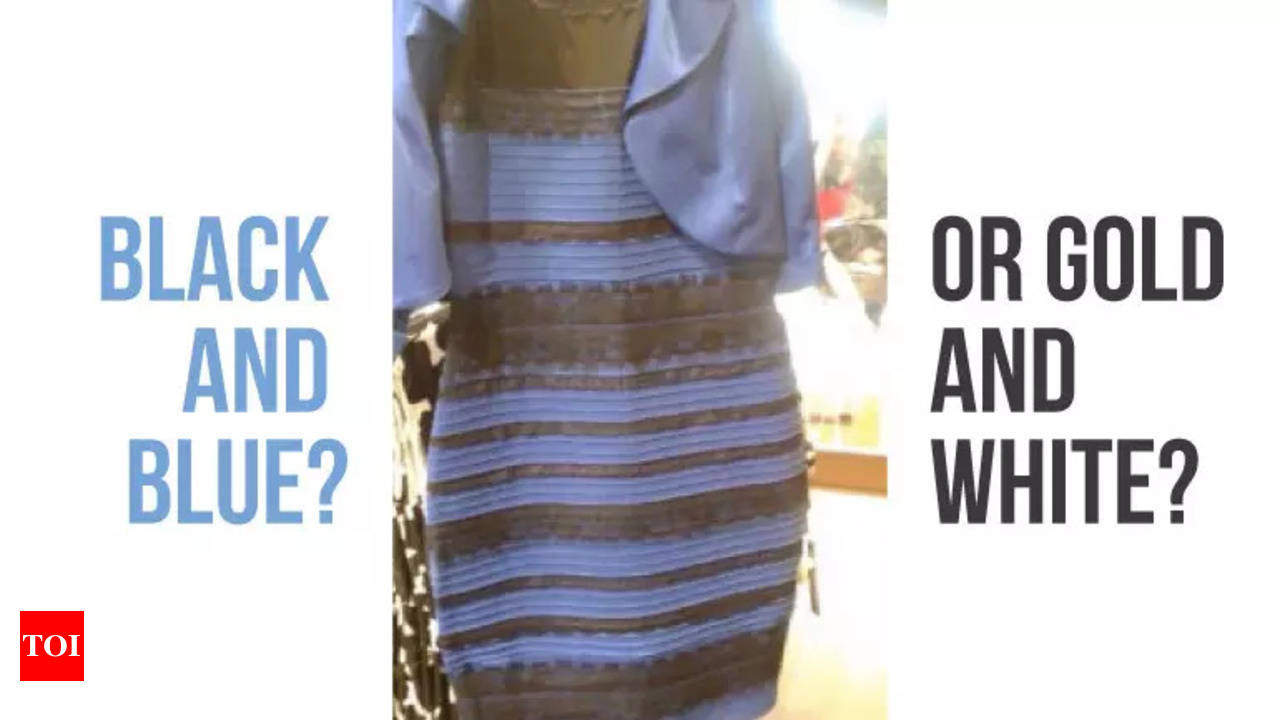
It started with a washed-out photo of a lace bodycon dress. February 2015. A Scottish wedding. A mother took a picture of a dress she planned to wear, sent it to her daughter, and inadvertently triggered a global digital civil war. You remember where you were. You probably got into a heated argument with a coworker or a spouse. One person saw blue and black; the other saw white and gold. Neither could understand how the other wasn't "trolling" them.
The dress optical illusion wasn't just a meme. It was a glitch in the Matrix that revealed how subjective our reality actually is.
Ten years later, we finally have the science to explain why your brain lied to you. It turns out that the dress optical illusion wasn't about the fabric at all. It was about the sun. Or, more specifically, it was about whether your brain thought the sun was shining on that fabric.
The Viral Spark: How a Low-Quality Photo Ruined Dinner Parties
The image originated from Cecilia Bleasdale, who took the photo at a shop in Cheshire, England. She sent it to her daughter, Grace Johnston, who then shared it on Tumblr after friends couldn't agree on the colors. From there, it hit Buzzfeed and exploded. At its peak, the site saw over 670,000 people viewing the post simultaneously.
It was a perfect storm. The photo was overexposed. The white balance was way off. The background was bright, but the dress itself was in a shadow. This ambiguity forced the human brain to make a choice.
Our eyes don't just "see" color. They interpret it. When light hits an object, it reflects back into our eyes. But that light is a mix of the object's actual color and the color of the light source illuminating it. To make sense of the world, our brains have a feature called color constancy. Basically, your brain subtracts the light source to find the "true" color.
If you’re in a room with warm, yellow light bulbs, your brain knows a white piece of paper is white, even though the paper is technically reflecting yellow light. It "discounts" the yellow. With the dress optical illusion, the brain had to guess the light source without enough data.
The Science of Shadows and "Larks" vs "Owls"
Neuroscientist Pascal Wallisch from New York University conducted one of the most famous studies on this phenomenon. He surveyed thousands of people and found a weirdly specific correlation: your sleep schedule might determine what color you see.
Wallisch's research suggests that if you are a "lark"—an early bird who spends a lot of time in natural daylight—you are more likely to see the dress as white and gold. Why? Because your brain is used to bright, blue-ish natural light. When it looks at the ambiguous photo, it assumes the dress is in a shadow. It subtracts the "blue" of the shadow, leaving you with white and gold.
Night owls are different. If you spend your life under artificial, yellow-tinted light, your brain is conditioned to subtract that warmth. When a night owl looks at the dress, their brain assumes the lighting is artificial. It filters out the yellow, leaving them seeing the "true" colors of the fabric: blue and black.
It’s kind of wild. Your lifestyle literally shaped your perception of a JPEG.
The Actual Physics
For the record, the dress was real. It was a "Royal-Blue Lace Bodycon Dress" made by the British retailer Roman Originals. It was blue and black. There was never a white and gold version for sale at the time of the viral explosion.
Why This Specific Image?
There are thousands of optical illusions out there. Usually, they involve lines that look slanted but are straight, or circles that look like they're spinning. Those are fun tricks. But the dress optical illusion was visceral because it felt like a betrayal of our senses.
Most illusions work the same way for everyone. We all see the "moving" circles. But with the dress, the population was split. Roughly 57% saw blue/black, 30% saw white/gold, and the rest saw something else entirely, like brown or blue/gold.
This is a concept called bistable perception. Think of the famous "Necker Cube" or the drawing that looks like both a rabbit and a duck. Usually, you can flip between the two versions once someone points it out. The dress was different. Most people were "locked in." Once you saw white and gold, it was almost impossible to see the blue and black, no matter how hard you squinted.
Technical Breakdown: Chromatic Adaptation
If you want to get nerdy about it, look at the RGB values of the pixels. If you drop that image into Photoshop and use the eyedropper tool, the pixels are actually shades of muddy blue and brownish-gold.
The reason some people see white is because of chromatic adaptation. If your brain decides the dress is being hit by a blue-ish light (like the sky or a deep shadow), it assumes the "blue" it sees in the pixels is just a reflection. It "corrects" that blue to white.
Conversely, if the brain thinks the dress is under yellow light, it sees the goldish-brown pixels as a reflection and corrects them to black.
Bevil Conway, a neuroscientist at the National Eye Institute, noted that this image hit a "biological sweet spot." The colors in the photo happen to fall right along the daylight axis. The world is naturally filled with blueish light (daylight) and yellowish light (sunset or incandescent bulbs). Because the photo was so poorly lit, it sat right on the fence of these two categories, forcing the brain to pick a side.
The Cultural Aftermath
The dress changed how we talk about reality on the internet. It was the first time a massive portion of the population realized that "seeing is believing" is a lie. Our brains are not cameras. They are prediction engines.
It also sparked a wave of new research into "The Yanny or Laurel" audio illusion and "The Shoe" (was it pink/white or grey/teal?). None of them quite captured the zeitgeist like the dress did. It was the "Big Bang" of perceptual memes.
Even brands jumped in. Roman Originals saw a 560% increase in sales. They eventually made a one-off white and gold version for a charity auction, which sold for nearly $3,000. It was a circus.
How to "Flip" Your Perspective
Can you actually change what you see? It’s hard, but not impossible. If you see white and gold and want to see blue and black, try these steps:
- Change the context. Crop the photo so you can only see the fabric and none of the overexposed background.
- Tilt your screen. Changing the viewing angle on a phone or laptop alters the contrast and brightness, which can sometimes "jolt" the brain into a different interpretation.
- Look at a high-quality photo of the real dress. Once your brain "knows" the truth, it might try to map that knowledge onto the blurry version.
Honestly, it’s still a struggle for most. The neural pathways are stubborn.
What This Teaches Us About Human Conflict
There is a deeper lesson here. If we can't even agree on the color of a dress—something as basic as visual input—how can we expect to agree on complex social or political issues?
The dress optical illusion proves that two people can look at the exact same set of facts and see two completely different realities based on their "internal wiring" and past experiences. It’s a humbling thought. Your "truth" is often just your brain’s best guess based on the data it has.
Actionable Insights for the Curious
- Check your monitor calibration: If everyone you know sees one color and you see another, check your "Night Shift" or "Blue Light Filter" settings. These can artificially shift your perception.
- Test your friends: Use the dress as a litmus test for how people process information. It’s a great way to explain the concept of "subjective reality" in a low-stakes environment.
- Explore other bistable images: Look up the "Rotating Dancer" or "The Coffer Illusion" to see how else your brain fills in the gaps of missing information.
- Acknowledge the bias: The next time you're in a disagreement, remember the dress. Remind yourself that the other person might literally be seeing a different "color" than you are, and they aren't necessarily crazy for it.
The dress is long gone from the headlines, but the science it unearthed continues to help researchers understand vision disorders and the way the human brain constructs the world around us. It remains the most important piece of lace in the history of the internet.